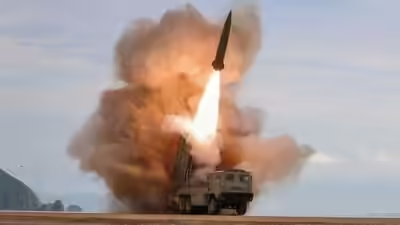
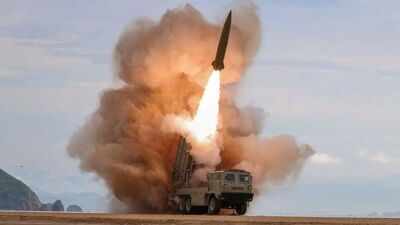
North Korean leader Kim Jong Un has overseen a series of artillery and missile tests, using the 76th anniversary of the outbreak of the Korean War to showcase Pyongyang’s efforts to strengthen firepower along its southern border with South Korea.According to North Korean state media KCNA, the tests involved an upgraded 240mm multiple rocket launcher, a tactical ballistic missile warhead and a 155mm self-propelled howitzer.Kim expressed satisfaction with the results and said the tests showed progress in developing weapons with greater accuracy, longer range and higher levels of automation. He said these capabilities were aimed at strengthening North Korea’s defence posture along the border with South Korea and ensuring that “no enemy dare to confront” the country.KCNA said the tests evaluated the combat characteristics of the upgraded 240mm, 24-tube multiple rocket launcher system, the power of a special mission warhead for a tactical ballistic missile, and the accuracy of extended-range shells fired from a 155mm self-propelled gun-howitzer.The rocket launcher system has been equipped with a self-steered precision guidance system and its range has been increased to 90km, KCNA said. That range would allow the system to reach parts of the Seoul metropolitan area from positions near the inter-Korean border.The ballistic missile warhead, according to KCNA, is designed to inflict “fatal damage” on key targets such as airfields, ports and power facilities.The latest tests come just a month after North Korea tested a mix of tactical ballistic missiles, artillery rockets and precision-guided cruise missiles, underlining Pyongyang’s continued focus on frontline strike capabilities.Korean War anniversaryThe tests were conducted around the anniversary of the outbreak of the Korean War on June 25, 1950. The war began when North Korean troops crossed the 38th Parallel and invaded South Korea in an attempt to unify the Korean Peninsula under communist rule.The peninsula had been divided at the end of World War II, with the North backed by the Soviet Union and the South supported by the United States. Two separate states were established in 1948, with both claiming legitimacy over the entire Korean Peninsula.After three years of brutal fighting, in which more than 2.5 million people were killed, an armistice agreement was signed on July 27, 1953, ending active hostilities. However, no peace treaty was signed, which means North and South Korea technically remain at war.Today, the two countries are separated by the 250km-long Demilitarised Zone, one of the world’s most heavily fortified borders.North Korea’s expanding arsenalOver the past decade, North Korea has rapidly expanded its nuclear and missile programmes. Pyongyang has shifted from simply possessing nuclear weapons to developing systems that can be deployed with frontline military units and used against regional targets.According to the Stockholm International Peace Research Institute, North Korea has assembled around 60 nuclear warheads and has enough fissile material to produce at least 30 more, even as it continues to expand production capacity.Kim has repeatedly said North Korea’s status as a nuclear weapons state is irreversible and has called for an “exponential” expansion of the country’s nuclear arsenal. He has also ordered the military to increase production of weapons-grade nuclear material.In 2025, North Korea continued to unveil and test new missile systems, including the solid-fuelled Hwasong-20 intercontinental ballistic missile and medium-range manoeuvrable systems designed to evade missile defences.North Korea has also deployed thousands of long-range artillery guns, multiple rocket launchers and tactical ballistic missiles near the Demilitarised Zone, which lies roughly 40km from the South Korean capital, Seoul.Why the latest tests matterThe latest display comes amid renewed attention on North Korea after South Korean President Lee Jae Myung discussed the situation on the peninsula with US President Donald Trump at the G7 summit in France. Trump later said it was time to “pay attention to the North Korea issue”, according to Lee.North Korea remains under multiple sets of United Nations sanctions over its nuclear weapons programme and use of ballistic missile technology. Pyongyang has repeatedly defied these restrictions, arguing that its weapons programme is necessary to deter the United States and South Korea.Kim has also said North Korea must strengthen what he described as a “deadly and destructive offensive posture”, even as he frames the country’s military expansion as a defensive necessity.For South Korea and the US forces stationed on the peninsula, the latest tests reinforce a long-standing security concern: North Korea’s ability to combine nuclear weapons, precision-guided missiles and long-range artillery to threaten Seoul and other key military and civilian targets.More than seven decades after the Korean War, the peninsula remains one of the world’s most volatile military flashpoints.
About the Author