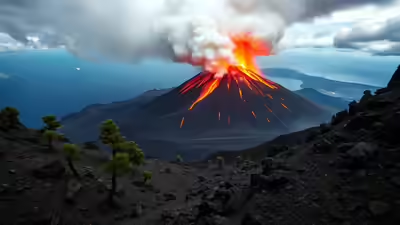
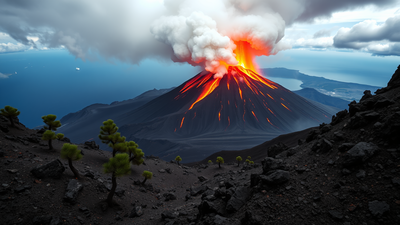
Mount Etna in Italy is one of the most well-studied volcanoes in the world. It has been erupting for thousands of years, and scientists have been observing it closely for decades. But a new study from Cornell University has revealed something surprising: two of Etna’s most powerful eruptions from the ancient past were not just different in scale, they were driven by completely different underground processes, operating through separate pathways, at different depths, and on very different timescales. The findings, published in the journal Geochemistry, Geophysics, Geosystems, change the way scientists think about how a single volcano can behave, and they have important implications for how future eruption risks are assessed not just for Etna, but for volcanoes around the world.
What makes a volcanic eruption explosive, and why gases are the key
Before getting into what made Etna’s two ancient eruptions so different from each other, it helps to understand what controls how explosive a volcanic eruption actually is. The answer lies mostly in gases, specifically the gases that are dissolved inside magma, the molten rock that rises from deep underground.Think of it like a bottle of fizzy soda. If you open the bottle slowly and calmly, the gas comes out gently, and the drink stays mostly in the bottle. But if you shake the bottle first and then open it, the gas is released all at once, and you get an explosion. Magma works similarly. The gases dissolved inside it, mainly water vapour and carbon dioxide, are what drive eruptions. How fast those gases escape, and from what depth, determines whether an eruption is slow and gentle or violently explosive.For a long time, scientists believed that water was the main gas controlling most volcanic eruptions. But in 2023, the same Cornell-led research group showed that carbon dioxide can also trigger explosive volcanic eruptions a finding that opened up a whole new way of thinking about what is happening deep inside volcanoes before they blow.
The new technique that lets scientists see inside ancient eruptions
One of the most important parts of this research is the method the team used. Rather than relying only on rock samples collected from the surface after an eruption, the researchers used a technology called Raman spectroscopy to study tiny crystals formed inside magma as it moved through the Earth. These crystals can trap microscopic bubbles of gas, some so small they are only 1 to 10 per cent as thick as a single human hair.By measuring the density of the carbon dioxide trapped inside these bubbles, the scientists were able to calculate the pressure at which the bubbles formed. And pressure can be converted directly into depth, telling researchers exactly how far underground the magma was when that particular crystal grew. As lead author Maxim Gavrilenko of Cornell explained, this technique allows the team to reconstruct the plumbing system of a volcano with a precision that was not possible before, giving an almost step-by-step picture of how magma moved underground during a historical eruption.
The 122 BC eruption: how magma stalled underground before exploding
The first eruption the researchers focused on happened in 122 BC and is one of the largest on record from Mount Etna. It was what geologists call a Plinian eruption the most explosive category, named after Pliny the Elder, who documented the famous 79 AD eruption of Mount Vesuvius. It was also mafic, meaning the magma was low in silica and relatively fluid, rich in iron and magnesium.Using their crystal analysis technique, the Cornell team found that during the 122 BC event, magma started rising slowly from a depth of about 22 kilometres underground. But instead of continuing straight to the surface, it stalled at a shallow level just 2 to 5 kilometres deep where it sat for several weeks. During that waiting period, the magma gradually lost its dissolved gas. When it finally did erupt, it did so explosively, with water vapour playing the dominant role in driving the blast.This is a relatively shallow, water-driven mechanism the kind that most scientists have long associated with volcanic explosions. But the second eruption told a very different story.
The Fall Stratified eruption: a faster, deeper, CO₂-driven blast from 4,000 years ago
The researchers also studied an older eruption known as the Fall Stratified event, which happened roughly 4,000 years ago. When they compared crystal data from both eruptions, the differences were striking. In the Fall Stratified case, magma did not stall underground or gradually lose its gas. Instead, it surged upward very quickly from a much greater depth between 24 and 30 kilometres below the surface and reached the surface within hours.The driving force this time was not water but carbon dioxide, present in much higher concentrations. CO2 is less soluble in magma than water, which means it starts bubbling out at greater depths and builds up pressure much faster as the magma rises. When enough CO2 is present, the eruption can be triggered from far deeper underground, happen much faster, and give far less warning than a shallower, water-driven event.The study, published, explains this difference clearly: when CO2 concentrations are high enough, eruptions come from very deep and happen very fast. When water is the dominant volatile, the process plays out closer to the surface and over a longer period of time.
Why Mount Etna is uniquely suited to studying both types of volcanic behaviour
Most volcanoes around the world are dominated by one type of volatile. Volcanoes on oceanic islands like those in Hawaii tend to have higher CO2 levels. Volcanoes in subduction zones where one tectonic plate slides under another, as in much of South America and Southeast Asia tend to be water-dominated. Mount Etna sits in a rare middle ground where both volatile systems are active and competing, making it one of the best natural laboratories on Earth for studying how these two mechanisms interact.Professor Esteban Gazel, who led the project, noted that Etna is unusual precisely because it sits at the intersection of these two different volcanic worlds. That is what made the discovery of two such distinct eruption pathways within the same volcano so significant Etna is essentially running both systems, and the dominant one at any given time determines the character of the eruption that follows.
About the Author