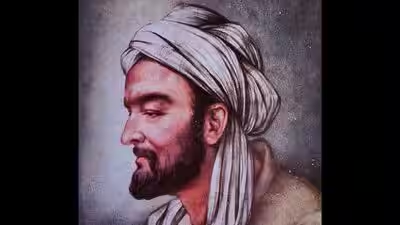
A knife can prepare a meal or cause harm. Fire can warm a house or burn it down. More than a thousand years ago, the Persian physician and philosopher Avicenna made the same point using something far more ordinary. “Is it the fault of wine if a fool drinks it and goes stumbling into darkness?” he asked. The line reads like a passing remark, but it comes from his own account of his life, and it is really a defence of personal responsibility rather than a comment about drinking. It is also one of the more human, personal fragments to survive from a scholar mostly remembered for dense medical and philosophical texts rather than reflections on his own late-night habits.
Quote of the day by Avicenna
“Is it the fault of wine if a fool drinks it and goes stumbling into darkness?”
Understand the meaning behind the quote
The question is rhetorical, and the answer is obviously no. Avicenna is separating an object from the person using it badly. If someone drinks carelessly and suffers for it, the wine has not done anything wrong. The judgement, or the lack of it, belongs entirely to the drinker.The wider point reaches well beyond wine. People often blame money for greed, technology for distraction, or power for corruption, when the object itself has no agency at all. Avicenna is arguing that responsibility cannot be handed off to circumstances or possessions. It stays with the person making the choice.
Where this quote actually comes from
This line survives as part of Avicenna’s own autobiography, dictated later in life to his student al-Juzjani. In it, he describes long nights as a young man in Bukhara, reading and studying by lamplight until exhaustion caught up with him. Rather than stopping, he would drink a cup of wine in moderation to restore his energy, then return to his books, sometimes working through difficult problems in his sleep and waking with the answers clearer in his mind.The line about wine and fools sits inside that same account, as his own justification for the habit against anyone who might judge it. He was not describing wine as something to be feared or celebrated. He was describing moderate, deliberate use in service of a clear goal, which is precisely the distinction the rest of the quote goes on to make.
Why Avicenna remains one of history’s great thinkers
Born in 980 CE near Bukhara, in what is now Uzbekistan, Avicenna became one of the most influential scholars of the Islamic Golden Age. His medical encyclopaedia, The Canon of Medicine, remained a standard reference across Europe and the Middle East for centuries, and his work also spanned philosophy, astronomy and mathematics.He treated these fields as connected rather than separate, believing that scientific observation and philosophical reflection strengthened each other. His comment about wine reflects that same habit of mind, taking something ordinary from daily life and using it to make a genuinely philosophical point about judgement and responsibility.
Why the tool is rarely the real problem
Every generation argues over whether a new invention is responsible for the problems that follow it, television, video games, smartphones, now artificial intelligence. Avicenna’s question cuts through that argument in advance. A smartphone can educate a child or distract them for hours. Neither outcome is decided by the device itself.The same logic applies to knowledge, wealth and influence. Each can build something or damage it, depending entirely on the judgement of the person holding it.
Wisdom starts with accepting responsibility
People naturally look for something outside themselves to blame when things go wrong, circumstances, other people, bad luck. Avicenna’s question makes that harder to do convincingly. If the object itself was never responsible, the explanation has to come from somewhere closer to home.This does not deny that some circumstances really are unfair. It simply points out that character shows up in how someone responds within those circumstances, not in the circumstances themselves.
Other memorable quotes by Avicenna
- “The world is divided into men who have wit and no religion and men who have religion and no wit.”
- “The knowledge of anything, since all things have causes, is not acquired or complete unless it is known by its causes.”
- “Medicine considers the human body as to the means by which it is cured and by which it is driven away from health.”
- “The more brilliant the lightning, the quicker it disappears.”
Why this still holds up today
More than a thousand years later, people still have unprecedented access to money, technology, knowledge and influence, and still argue over whether these things are good or bad in themselves. Avicenna’s answer was already there. None of them decide anything on their own.Lasting progress depends on pairing whatever tools a generation inherits with the wisdom to actually use them well. Avicenna’s question was never really about wine. It was about where responsibility genuinely sits, which turns out to be exactly where it has always been, with the person making the choice.
About the Author