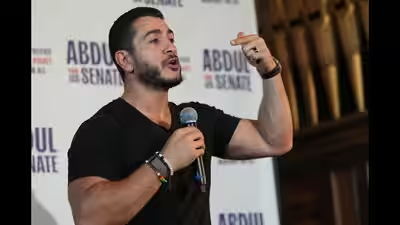
TOI correspondent from Washington: The United States is edging towards its first ever Muslim Senator after Abdul El-Sayed, an Egyptian-American physician, Rhodes scholar, podcaster and progressive insurgent, defeated the Democratic establishment backed four-term Representative Haley Stevens in one of the most closely watched and bitterly fought primaries of the 2026 election cycle. If he goes on to defeat Republican Mike Rogers in November, El-Sayed will break one of the last symbolic barriers in American politics, which has not seen a Muslim elected to the Senate in the 250 years after the republic’s founding.El-Sayed victory, coming amid a MAGA-infused America, is about much more than Michigan; it is another unmistakable sign that even the Democratic Party’s restless grassroots increasingly resembles an unruly family reunion where the children have wrestled the remote control away from the parents. While the old guard still command the cheque books, newcomers are increasingly winning the applause and the votes, and so it was on Tuesday night when persistence of the son of Egyptian immigrants’ trumped patronage of the establishment.El-Sayed, who was born near Detroit, accumulated degrees from the University of Michigan, Columbia and Oxford as a Rhodes Scholar before leading Detroit’s health department. He first burst onto the national political scene in 2018 during an unsuccessful gubernatorial bid, but instead of disappearing into consulting or cable television, he plodded through retail politics, patiently building a progressive political network across Michigan.His party rival Stevens enjoyed endorsements from Senate Minority Leader Chuck Schumer, Governor Gretchen Whitmer, outgoing Senator Gary Peters and much of the Democratic establishment. Outside groups, including pro-Israel outfits, poured tens of millions of dollars into supporting her campaign. Outspent, El-Sayed countered with volunteers, small donors, Bernie Sanders, Alexandria Ocasio-Cortez, Elizabeth Warren, and an argument that corporate money has corrupted America.The ideological fault lines running through today’s Democratic Party were visible in almost every issue that defined the campaign. El-Sayed advocated Medicare for All, higher taxes on the wealthy, removing corporate money from politics and ending U.S. military aid to Israel, describing the Gaza war as genocide. Stevens offered a more centrist, pragmatic message built around manufacturing, electability and traditional Democratic coalition-building. The contest became a proxy war over Israel, campaign finance, and the party’s future identity.Progressive victories over establishment Democrats have become increasingly common in safely Democratic urban districts from Berkeley to Brooklyn. But winning a statewide Senate primary in one of America’s premier battleground states like Michigan is a different deal altogether. It suggests that progressive economics, anti-establishment populism and skepticism toward corporate influence are finding traction beyond the party’s coastal strongholds. Michigan is perhaps the clearest indication yet that progressive candidates can no longer be dismissed as niche activists appealing only to deep-blue enclaves.The broader historical rhythm is also hard to ignore. Barack Obama’s election in 2008 symbolized a generational and demographic transformation that convinced many Americans the country had entered a new political era. But it also intensified partisan polarization and ultimately contributed to Trump’s populist victory in 2016. American politics has spent much of the last decade oscillating between those competing visions. It now appears the pendulum may be swinging back again.El-Sayed’s nomination reflects not only America’s growing diversity but also the frustration of younger Democrats with incrementalism, inequality and institutions they increasingly regard as captured by wealthy interests. The Establishment argues such candidates risk alienating swing voters; rebels counter that cautious centrism has produced too many narrow defeats and too little inspiration. Whether Michigan becomes proof of progressive electability or merely another fascinating primary upset will be decided in November, when El-Sayed faces Trump-backed Republican Mike Rogers in a race likely to determine control of the Senate.For now, though, one conclusion is unavoidable: The Democratic bosses may still own the party’s furniture, but insurgents have begun rearranging the house. And judging by Michigan, they’re no longer asking permission before moving the sofa.
About the Author