Solar panels are designed to capture sunlight above the water, but researchers have now shown that specially designed solar cells can also generate electricity underwater. The team developed wide-bandgap perovskite solar cells and tested them at a depth of 10 metres in the South China Sea. The cells produced electricity from the limited light available underwater and were also fitted to underwater robots during field tests. As per the research published in the journal Joule, laboratory experiments showed that the devices could retain their performance during extended storage and simulated underwater conditions. The researchers say the technology could eventually power equipment operating beneath the ocean surface.
How the underwater solar cells produced electricity
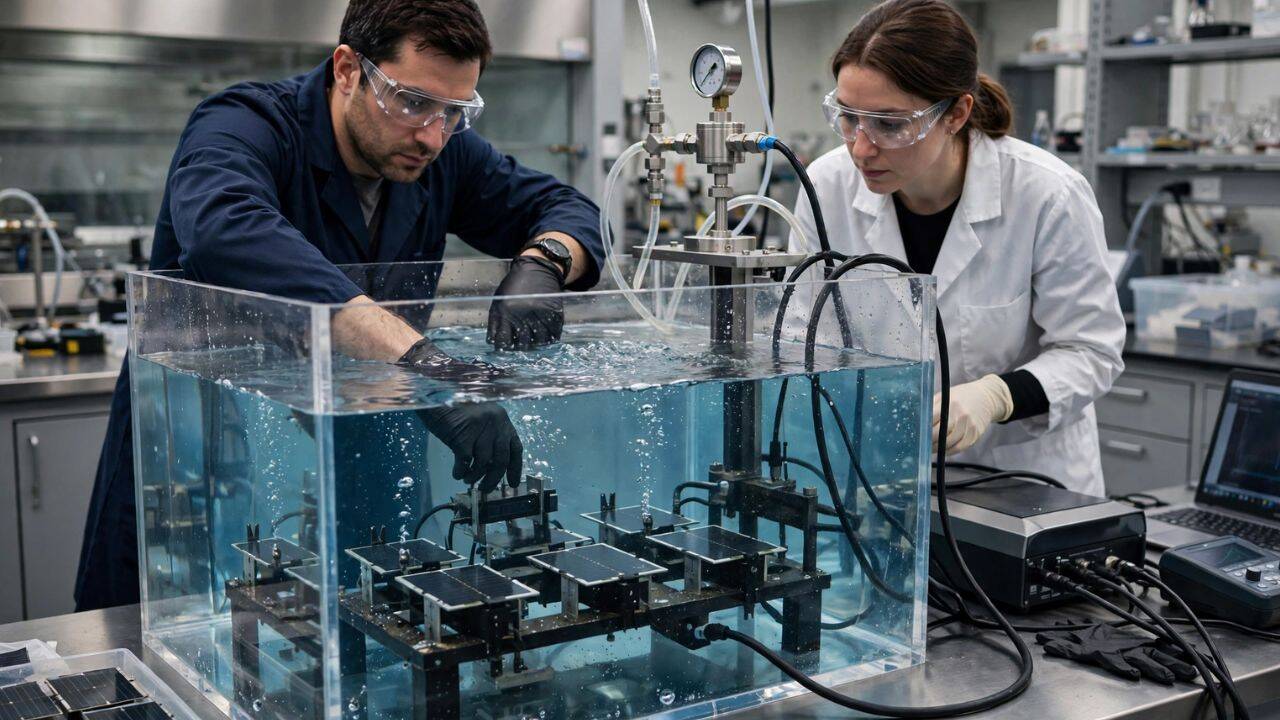
The researchers designed the perovskite solar cells to make better use of the limited light that reaches underwater environments. As sunlight travels through water, its intensity decreases, and its spectrum changes with depth. To address this, the team used wide-bandgap materials that can absorb the blue-to-orange wavelengths that remain available underwater. They first recreated underwater lighting conditions in the laboratory to test how the cells performed at different depths.The devices were then tested under conditions equivalent to 10 metres of water, where they continued to generate electricity. The experiments showed that solar power can be harvested at meaningful underwater depths. The researchers also demonstrated that the technology could be developed from small laboratory cells into larger solar modules.
PC: AI Generated
Solar modules generate 324 mWh during underwater testing
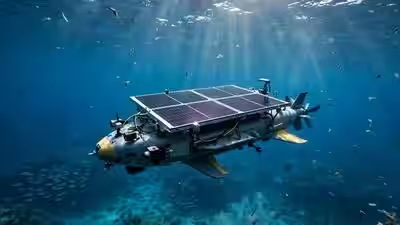
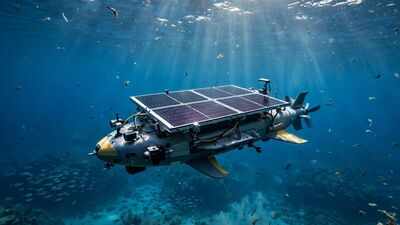
After completing the laboratory tests, the researchers took the technology into the sea for real-world trials. They integrated the perovskite solar cells with underwater robots and deployed the system at a depth of 10 metres near the Weizhou Islands in the South China Sea. During the two-hour test, the larger solar modules generated 324 milliwatt-hours of electricity under underwater light.The trial allowed the team to assess the cells in actual marine conditions rather than relying only on simulated environments. It also showed that the technology could be expanded beyond small laboratory cells into larger modules. By combining controlled laboratory experiments with open-water testing, the researchers demonstrated that their solar cells can generate usable electricity underwater and work alongside autonomous underwater systems.
How durable are the new underwater solar cells
The researchers also looked at how well the solar cells could maintain their performance over extended periods. In one experiment, the devices were kept in a nitrogen-filled glove box for 300 days. When tested again, they retained about 96% of their original efficiency. The team then exposed the cells to simulated underwater conditions equivalent to a depth of 10 metres for 1,160 hours.The devices showed almost no noticeable degradation during this period. Based on these results, the researchers estimated that the solar cells could operate continuously at 10 metres for around 5.5 years under the study’s conditions. The findings highlight the long-term stability of the wide-bandgap perovskite design for underwater energy systems.
Underwater solar cells could support sensors, cameras and robots
The researchers see underwater photovoltaics as a potential power source for equipment that operates beneath the ocean surface. Sensors may need to run for long periods, while cameras and communication systems require a steady supply of electricity. The solar modules tested in the study could generate power directly underwater, which may reduce the need for batteries in some applications.The field trials also showed that the technology can be integrated with moving underwater robots. However, the researchers tested the system at a depth of 10 metres. The results demonstrate the potential of underwater solar generation but do not yet show that it can replace established power systems used by equipment operating at greater ocean depths.
Could underwater solar power work beyond 10 metres
The researchers now plan to test how the solar cells perform at greater depths and identify the practical limits of underwater photovoltaic generation. They also want to establish standard testing methods so different underwater solar technologies can be assessed under the same conditions. The current study showed that the wide-bandgap perovskite cells can generate electricity at 10 metres while maintaining their performance during extended tests.Further trials will reveal whether the cells can continue producing useful amounts of power as sunlight becomes weaker with increasing depth. For now, the findings provide a basis for developing solar-powered systems that can operate beneath the ocean surface and potentially support equipment that needs to remain underwater for long periods.
About the Author