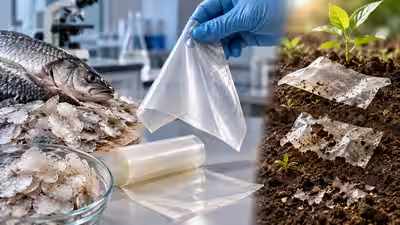
Scientists have turned discarded fish scales into a plastic-like material that can break down naturally in soil, Cyclo. Plas 2, the material is made from collagen fish scales and chitosan, creating a thin, flexible, translucent film. In tests, the material began breaking down after two weeks and biodegraded by the end of eight weeks. It also showed resistance to water and heat, while plants grown in soil containing the material showed no signs of toxicity. The researchers say the work could give fish-processing waste a new use and provide another possible alternative to some conventional plastic products.
How did scientists turn fish scale waste into plastic
According to the study published in Youth STEM 2030, titled ‘Cyclo.Plas 2: A Dual Focus Development as Alternative Materials to Plastic by Upcycling Fish Scale Waste Components’, the researchers say fish processing can generate substantial amounts of waste. Between 20% and 80% of a fish, including bones, fins and scales, may be discarded after the flesh is harvested. The paper notes that poorly managed fish waste can contribute to problems such as landfill accumulation and environmental pollution. Fish scales themselves contain Type I collagen as well as calcium salts, giving researchers useful materials to work with.For the thin-film version of CP2, the researchers recovered collagenous material from fish scale waste and combined it with chitosan. The process, described as sclerotisation, was intended to strengthen the collagen matrix while improving its resistance to water and heat. Three collagen-to-chitosan ratios were tested: 90/10, 70/30 and 50/50. All three produced translucent, flexible sheets with a slightly pale-yellow colour.
Fish scale plastic shows comparable tensile strength
Testing found that the CP2 thin film had tensile strength comparable to the earlier Cyclo. Plas material, with differences of up to 1.2% between the versions tested. The 90/10 collagen-to-chitosan film recorded the highest average tensile strength among the CP2 ratios examined. The researchers noted, however, that additional statistical analysis and trials would be needed to confirm the size of the improvement.The material also showed improved behaviour at higher temperatures. Between 140°C and 150°C, CP2 films recorded maximum shrinkage of about 25% to 31%, compared with 50% to 54% for thin low-density polyethene (LDPE) tested in the study. The CP2 film also remained translucent, recording 86% visible-light transmittance at 550 nm for 0.53mm thick.
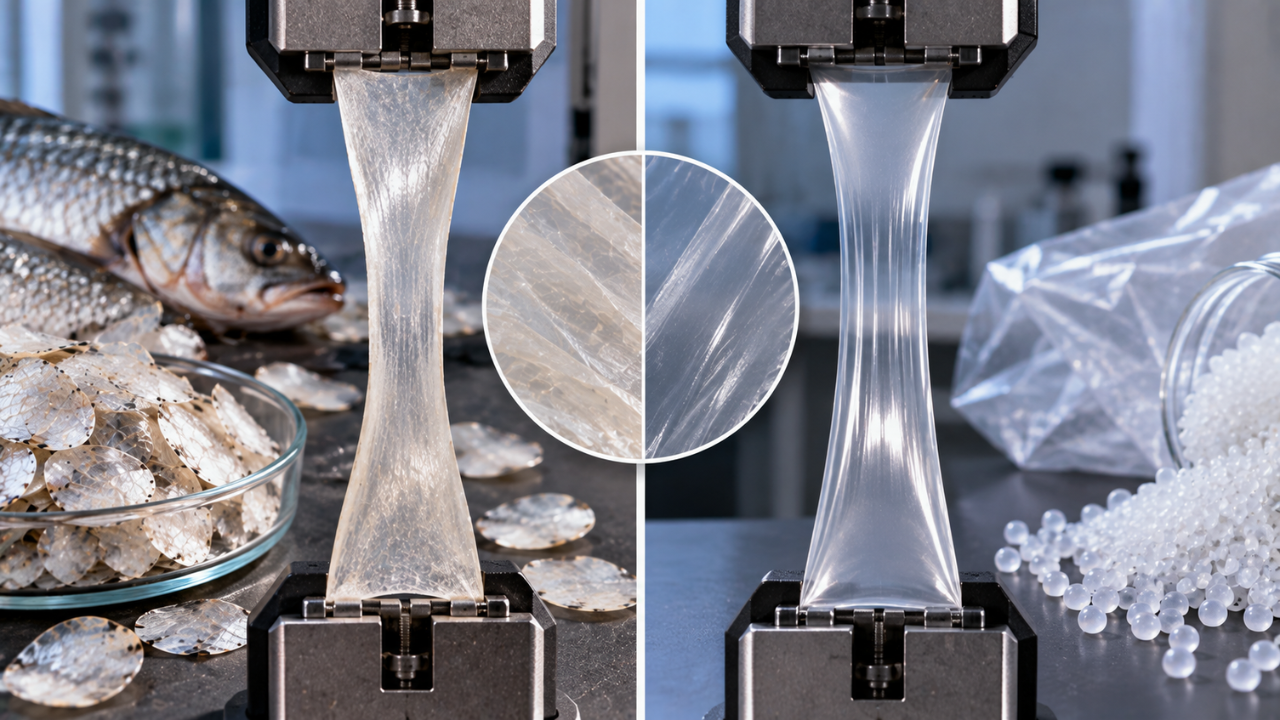
Image AI generated
Fish scale plastic biodegrades within eight weeks
One of the most notable findings involved what happened to the material after disposal. The researchers mixed different quantities of CP2 thin film with organic soil and monitored the samples for eight weeks. All the CP2 samples tested successfully biodegraded in the soil during that period. Breakdown began during the second week, while the remaining scale matrices became softer and continued to degrade, leaving little visible material by the end of the eighth week.During four weeks of phytotoxicity testing, all plants survived and showed no signs of phytotoxicity. Overall plant growth was 3% to 7% higher than the control in the test, although the researchers noted some variation at higher CP2 quantities. They said further investigation is required to establish the material’s longer-term environmental effects and its potential use as a fertiliser.
Plastic could be used for packaging and bags
The study also developed a second form of CP2 by combining waste 3D-printed PLA with hydroxyapatite derived from the fish-scale concept. The resulting composite had higher flexural strength than the control PLA waste in testing. Its degradation was also affected by the amount of HAp present, with higher HAp ratios generally accelerating degradation in the tested conditions. In home composting experiments, the CP2 composite degraded by approximately 7% over 12 weeks, more than three times the degradation observed in the control.The researchers suggest that CP2 could eventually be used in packaging, grocery bags, containers and other single-use products, as well as some forms of non-medical personal protective equipment. They describe the material as a potential way to give fish-scale waste another use while reducing reliance on conventional plastics. However, the study also identifies further work needed, including developing CP2 directly from raw fish-scale waste, testing it in simulated saltwater and producing prototypes closer to real-world applications.
About the Author