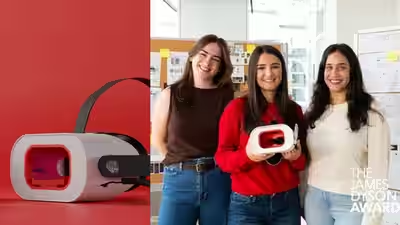
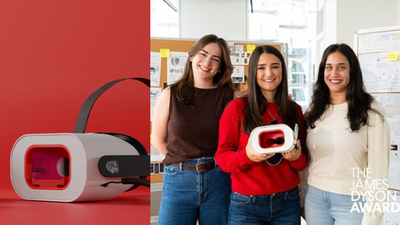
Radhika Saran, Cleo Pontone and Sophia DeVito, three students at Harvard University, have built Rumble Rims, a low-cost infrared eye-tracking headset that helps schools screen for possible concussions on the sideline in about 60 seconds. The system is designed to give coaches more objective information during sideline checks. The project has already earned the team the 2026 US James Dyson Award and a Red Dot Design Award. Here’s what inspired the idea, how it was designed, and what the team plans to do next.
What inspired Rumble Rims and how the headset works
The idea began with a simple question, why do young athletes rely on subjective sideline checks when more objective tools exist, locked inside clinical systems that can cost around $50,000? The team wanted coaches, athletes and families to have clearer information at the exact moment of risk, without needing a hospital or specialist equipment. Rumble Rims works as a three-part system; an infrared headset with two side-mounted cameras and angled hot mirrors that reflect infrared light to the cameras while letting visible light pass through, a coach-facing mobile display, and a recovery dashboard. The test tracks how an athlete’s eyes move and uses this information to look for possible signs of a concussion. It does not require a previous baseline test.
Design process: From bulky prototypes to a wearable headset
The team began by identifying the sideline itself as the weak point in concussion care, since accurate screening tools existed but weren’t built for school environments. Early prototypes explored helmets, mouthguards, a black-curtain room and expandable structures enclosing the screen, camera and athlete’s face, teaching the team lessons about lighting, head stability and screen distance, but proving too bulky for sideline use. Testing chin rests and head-motion correction revealed that accuracy depended less on building a controlled room and more on controlling the relationship between the eyes and the cameras. That insight led to the final headset, which moves with the athlete’s head to reduce relative motion, with simple anthropometric setup cues such as “one arm’s distance” for coaches under pressure.
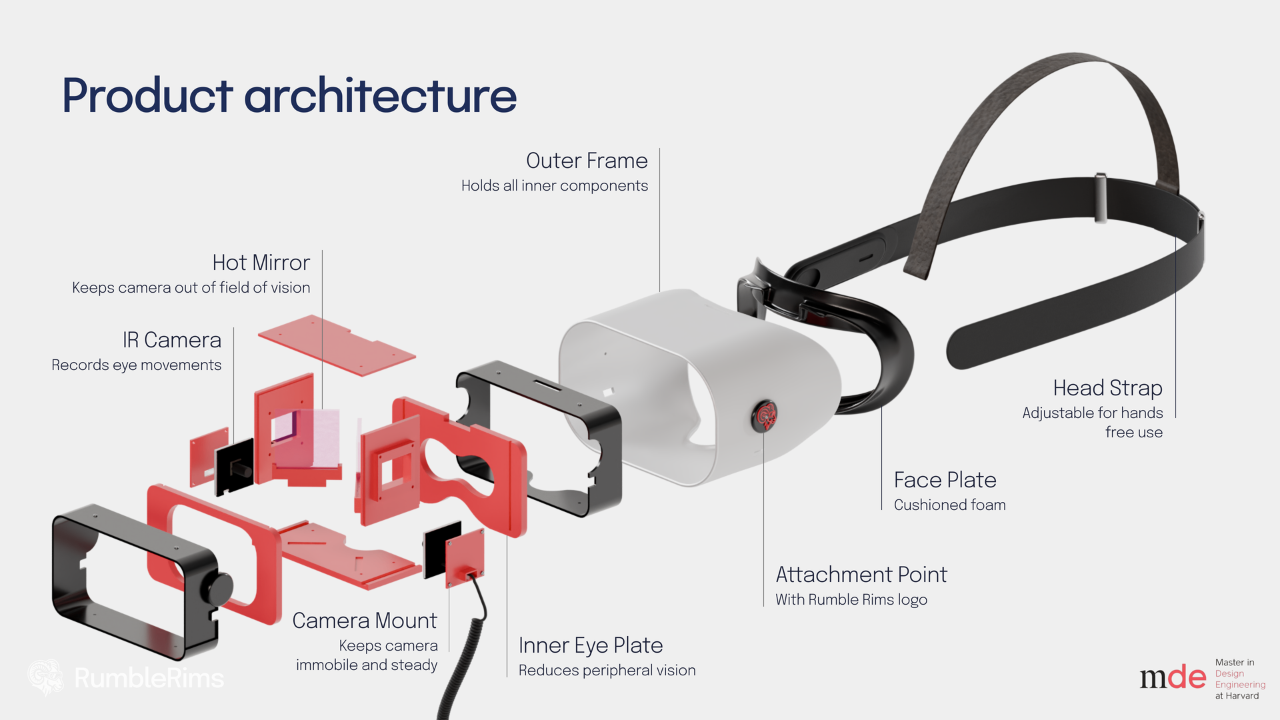
Product architecture and assembly (Image: Rumble Rims)
What makes Rumble Rims different from the existing concussion tools
Most concussion tools sit at two extremes, either expensive clinical systems schools can’t afford, or low-cost checks that depend heavily on human judgement. Rumble Rims is designed to combine objective eye-tracking, sideline portability and affordability into a single system used where the injury actually happens, functioning as a full care pathway from impact through to clearance rather than a single device. The project has been recognised with the Red Dot Design Award in the Medical Devices and Technology category, as well as the 2026 US James Dyson Award. Radhika Saran told PR Newswire that objective tools “should not be locked inside expensive clinical systems,” and should instead be accessible where young athletes actually get injured.
What’s next for Rumble Rims, the future of concussion tools
The team’s next step is to build and test a higher-fidelity headset prototype, refine the oculomotor test, and validate the system with athletes, coaches, trainers and medical advisors, with a focus on accuracy, usability, comfort and cost. Longer term, they hope to pilot Rumble Rims with schools and youth sports programmes and pursue medical-device validation pathways. Cleo Pontone told PR Newswire that the strongest solutions start with understanding the people who will use them and the environments in which they’ll be used. Rumble Rims now advances to the next stage of the James Dyson Award, with the international ‘Top 20’ shortlist due on 14 October.
About the Author