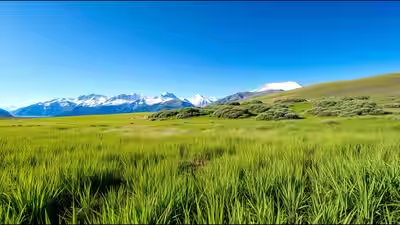
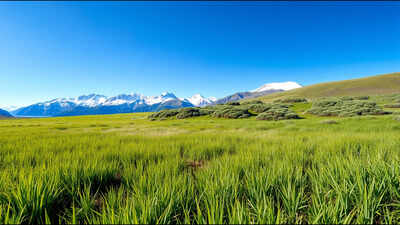
A 29-year climate-warming experiment in Colorado has documented a major shift in a subalpine grassland, with shrubs increasing by 150% while grasses and forbs, including wildflowers, declined by about 28%. The findings come from one of the world’s longest-running climate-warming experiments, conducted at the Rocky Mountain Biological Laboratory near Gothic, Colorado. In a study published in the Proceedings of the National Academy of Sciences titled Experimental warming decouples plant–fungal symbiont interactions and leads to a more conservative ecosystem, researchers found that long-term experimental warming shifted the vegetation from a forb- and graminoid-dominated community towards one dominated by Artemisia shrubs. The changes above ground were accompanied by changes in the soil fungal community, including declines in root-associated fungi and an increase in saprotrophic fungi. The researchers concluded that prolonged warming had shifted the meadow towards a more conservative ecosystem, with weaker associations between plants and some of their fungal partners.
Warming changed the meadow’s plant community
The experiment involved warming plots at the site for 29 years. The researchers found that the long-term treatment produced a transition from herbaceous vegetation towards woody-dominated vegetation. Shrubs increased by 150% in warmed plots compared with ambient plots, while the abundance of both forbs and graminoids declined by about 28%.The change was accompanied by a shift in plant functional traits of about 20% towards more conservative values. In ecological terms, conservative strategies are associated with retaining resources for longer, rather than investing as heavily in rapid growth and resource acquisition. The researchers therefore characterised the warmed ecosystem as becoming more conservative in its use of nutrients and other resources. The experiment also produced a change in plant biomass. Aboveground plant biomass was 64% higher in warmed plots after 29 years, while belowground plant biomass did not show a significant response. This indicates that the warming treatment changed the balance of plant biomass above and below the soil surface, alongside the broader change in plant composition.
Changes were also found below ground
The shift in vegetation was accompanied by changes in soil conditions and microbial communities. The researchers found that plant-available phosphorus increased under warming, while bulk soil enzyme activity declined by 10%. They suggest that the reduction in enzyme activity may be related to the greater contribution of shrub-derived, more resistant organic material to the soil.Soil organic matter, however, did not change after 29 years of warming. The researchers noted that some changes in soil carbon pools observed earlier in the experiment had not persisted over the longer period. These findings contributed to the researchers’ description of the warmed ecosystem as having a more conservative nutrient and carbon economy. The study does not establish that the changes in soil communities were caused specifically by the shift in vegetation. Because the researchers sampled the ecosystem at a single point after the long-term treatment, they could not determine whether changes in plants caused changes in fungi, whether fungal changes contributed to the plant shift, or whether both were responses to warming.
Plant-fungal relationships became weaker
The researchers also found changes in the fungi associated with plant roots. Arbuscular mycorrhizal fungi form relationships with plants in which the fungi can help their hosts obtain nutrients from soil while receiving carbon from the plants. The study found that root-associated fungal colonisation declined under warming. The paper’s abstract reports that arbuscular mycorrhizal fungal and septate root colonisation both declined by about 17% to 20% under the warming treatment.The relationship between plants and AM fungi also became less tightly coupled. Under ambient conditions, plant and AM fungal communities were strongly associated with one another, but this relationship weakened under warming. At the same time, saprotrophic fungi, which obtain nutrients by breaking down organic material rather than forming mycorrhizal partnerships with living plants, increased by about 10%. The researchers interpret these changes as evidence that the ecosystem’s dependence on plant-fungal nutrient partnerships was changing alongside the shift in vegetation. They suggest that weaker plant-mycorrhizal associations could affect nutrient transfer and contribute to the more conservative nutrient and carbon economy observed in the warmed plots.
The 29-year experiment captured changes that short studies can miss
The length of the experiment is significant because many experimental warming studies operate for much shorter periods. A nearly three-decade treatment allowed researchers to examine ecological responses that developed over a much longer period. After 29 years, the warmed plots differed from the ambient plots in plant composition, plant functional traits, biomass allocation and relationships between plants and soil fungi. The authors describe the resulting community as having shifted from a forb- and graminoid-dominated grassland towards a shrub-dominated and more conservative state. The researchers also note that the findings should not automatically be assumed to apply in exactly the same way to every mountain ecosystem. The response of vegetation and soil organisms to warming can vary depending on local climate, soils, species composition and other environmental conditions.
A separate experiment is examining earlier snowmelt
The researchers are also investigating another consequence of changing mountain climate: the timing of snowmelt. This work is separate from the 29-year warming experiment. In April 2023, researchers began an early-snowmelt experiment at the site using 5 large plots. Snowmelt was advanced by about 2 weeks. Early results showed that mycorrhizal fungal growth advanced by about 1 week, while plant-root growth did not show a corresponding shift.The researchers are examining what this difference in timing could mean for interactions between plants and fungi. The experiment provides a separate test of how changes in the timing of seasonal conditions can affect belowground biological activity, alongside the much longer experiment examining the effects of sustained warming. Together, the studies show that long-term climate experiments can reveal changes in mountain ecosystems that are difficult to capture in shorter studies, from shifts in plant communities to changes in the relationships between vegetation and the organisms living in the soil.
About the Author