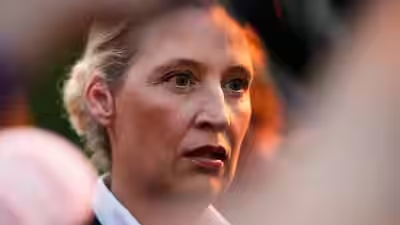
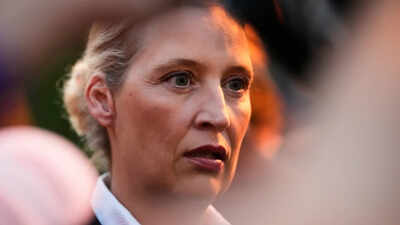
Since Sunday night in Magdeburg, when the Alternative für Deutschland took 43.9 per cent of the vote in Saxony-Anhalt against 17.2 for a Christian Democratic Union that had run the state for a quarter of a century, the question Germans have spent a decade avoiding has acquired a date and a number. The woman at the centre of it, and the reason a great many Germans find her difficult to place, is Alice Weidel.Consider the biography before the politics, because the biography is the politics. Weidel was born in Gütersloh in 1979, read business and economics at Bayreuth, wrote a doctorate on China’s pension system, worked for the Bank of China and spent six years in the country. She admires Margaret Thatcher, chiefly for the stubbornness. Her economics are the ordinary furniture of the free-market right: lower taxes, less bureaucracy, a return to nuclear power. She entered the Bundestag in 2017, became party co-chair with Tino Chrupalla in June 2022, ran as chancellor candidate in February 2025, and since May 2025 has been co-leader of the opposition to Friedrich Merz. In July this year her party re-elected her with 81.3 per cent, unopposed, which in the AfD counts as a coronation.She also lives in Einsiedeln in Switzerland with her partner Sarah Bossard, a film producer born in Sri Lanka and adopted by a Swiss couple, with whom she is raising two sons, while the party she leads campaigns on traditional families and hard borders. Commentators have been calling this a contradiction since 2017, which is generous of them, because it may be closer to a division of labour. Björn Höcke and the party’s radical wing supply the ideology and the court cases; Weidel supplies the CV, the fluency and the reassurance that nothing very frightening is going on. Someone has to be the acceptable face, and it helps enormously if the acceptable face genuinely believes she is one.The German state does not agree. The domestic intelligence agency classified the party as a confirmed right-wing extremist organisation in May 2025 after a report running past 1,100 pages, then suspended the label pending litigation; a court has since held that the agency may not use the “confirmed” tag, while the interior minister maintains that the party remains a legitimate object of observation. The AfD’s own Saxony-Anhalt branch, the one that just won 43.9 per cent, is classified by that state’s intelligence service as confirmed right-wing extremist. Weidel’s answer, delivered each time with the patience of someone explaining a spreadsheet, is that the whole apparatus is politically motivated. Roughly six voters in Saxony-Anhalt out of ten disagreed with the classification enough not to care.What actually broke on Sunday was not the AfD’s ceiling but the arithmetic of the Brandmauer, the firewall by which every other German party has refused coalition with the AfD. Chrupalla said the voters had struck it down, which is the sort of claim that sounds like spin until you count seats. To govern without the AfD, the CDU must assemble something delicate involving the Left party, which the CDU has also sworn never to touch. A firewall that requires two mutually exclusive vows is not a firewall; it is a scheduling conflict. Whether the AfD forms Germany’s first far-right state government since 1945 or merely watches its opponents fail to form anything, the party gains, and both the Berlin and Mecklenburg-Vorpommern elections are two weeks away.For an Indian reader the temptation is to file this under European curiosities, which would be a mistake for two reasons. The first is practical: Germany is India’s largest trading partner in the European Union and has spent three years courting Indian engineers, nurses and coders, and the politics of who is welcome there is now being written in Magdeburg rather than in Berlin ministries. The second is methodological. The lesson Weidel offers is not about immigration at all. It is that a movement the establishment considers unthinkable does not arrive wearing the uniform the establishment has been watching for. It arrives with a doctorate, a foreign posting, a mortgage in Switzerland and excellent manners, and it wins the argument about respectability long before it wins the vote.
About the Author