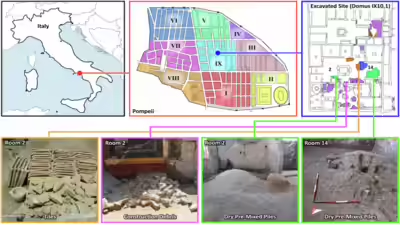
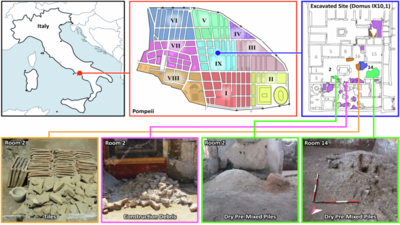
The resilience of Roman concrete has been considered one of those miracles lost from history for decades. Whereas most contemporary buildings would start showing signs of wear and tear within fifty years, the Roman aqueducts and piers have withstood two thousand years of being battered by sea waves and earthquakes. Most people believed that the ancient Romans had discovered a secret ingredient whose true nature eluded their comprehension. But now, thanks to an incredible discovery made on a building site still under construction in Pompeii, it has been proven otherwise.However, Mount Vesuvius’ eruption was not only a historical moment when a city was frozen in time, but also when an ongoing construction project was stopped. The research paper titled An unfinished Pompeian construction site reveals ancient Roman building technology conducted an analysis of construction waste and partially constructed walls that had been left in their place after the disaster. Based on these “frozen” data, it became clear that the formula for Roman concrete is not just a combination of materials but also the high temperatures of the mixing process itself.Hot mixing – An underestimated construction technique?It took scientists years to pay attention to the numerous small particles of white minerals, lime clasts, found in Roman mortar. Previously, experts believed that they appeared as a result of improper mixing or poor-quality materials used. However, the data obtained from the worksite in Pompeii showed that lime clasts were a by-product of hot mixing. As mentioned in the research above, constructors heated quicklime and then mixed it with dry volcanic ash.This unique reaction causes heating of the whole solution to such an extent that the lime does not get dissolved, resulting in white clasts that react easily. As cracks develop within the concrete years later, rainwater finds its way through the cracks and reacts with the lime blocks present there, which crystallise and seal off the cracks. This creates a self-healing living material that repairs itself within centuries; a feat that modern buildings are only just starting to mimic.
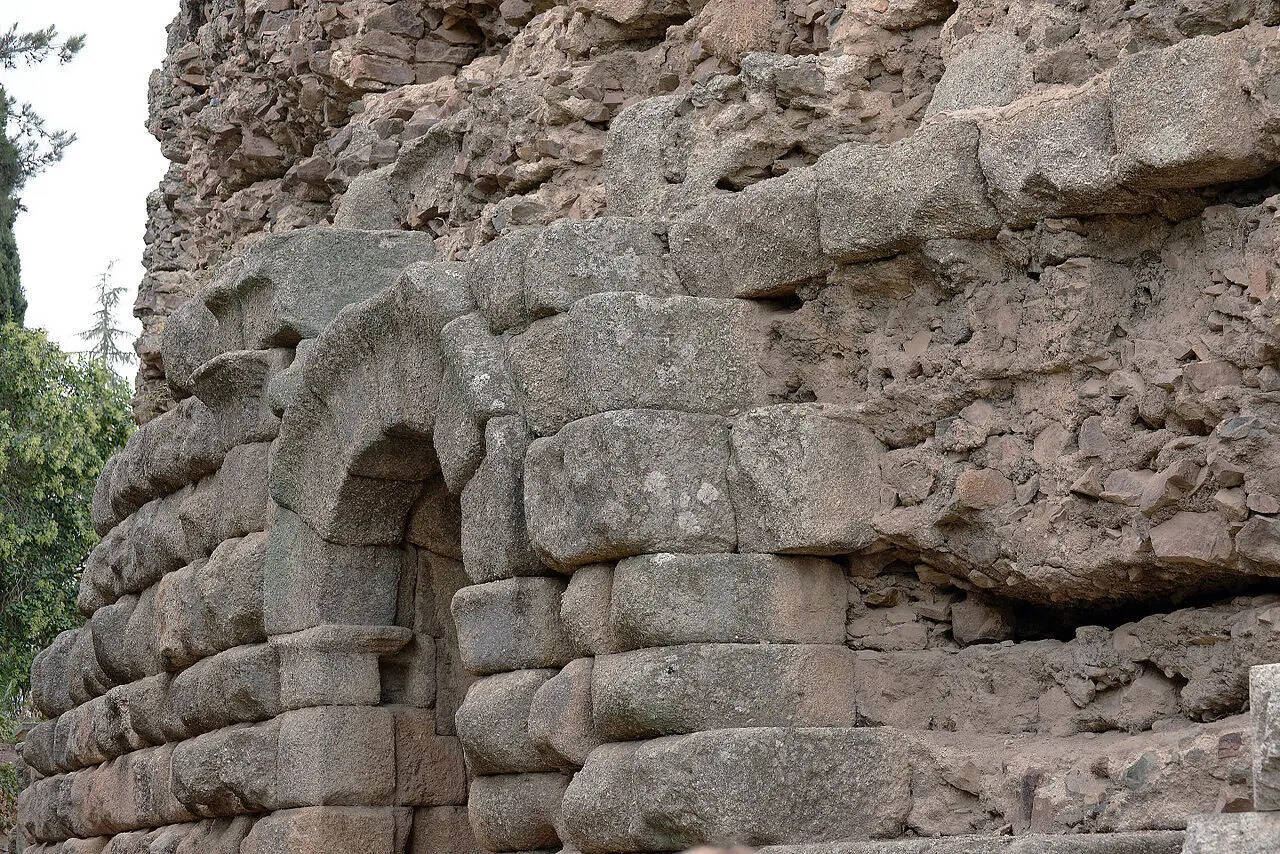
This technique, involving heating quicklime and volcanic ash, created self-healing concrete that repairs cracks over centuries. This ancient method offers a sustainable solution for modern construction, significantly reducing its carbon footprint. Image Credits: Wikimedia Commons
From ruin to resilienceThe beauty of this discovery lies in the fact that the very place where everything perished turned out to be the ultimate repository of information on resilience. Before this particular finding, researchers could only study concrete samples that had been around for many years; the incomplete construction gave them access to an understanding of what the original concoction was like. They could then confirm that it was indeed a widely used process in constructing buildings.The impact of such research is huge on the current world. According to a news report published by MIT News, Pompeii sheds light on ancient Roman building technology. It has been advised by the specialists that if the process of hot mixing is used in the current construction industry, there will be a considerable decrease in the carbon footprint of the industry.The tale of Roman concrete is one that is not of “lost magic” or happenstance. Rather, it is a tale of a people who were careful craftspeople, who knew the chemistry of their world inside and out. They didn’t just construct in order to serve their time period, but they harnessed the power of volcanic earth to ensure that their legacy lives on after ours. Through an unfinished construction site, we have found our way to everlasting building plans.
About the Author