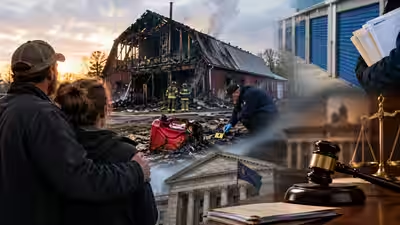
In November 2020, a fire damaged Antonne and Lisa Gose’s barn-style property in Richmond, Indiana. Investigators concluded that the fire had been deliberately set but did not identify who was responsible. The couple said they were out of state when it happened and denied involvement. Their insurer, Indiana Farm Bureau Insurance, denied their claims, citing suspected arson and the couple’s failure to authorise access to records from a storage facility. The Goses sued for breach of contract and bad faith, but a trial court ruled for the insurer.On October 23, 2026, the Indiana Court of Appeals reversed that decision, allowing both claims to proceed. The court found that factual disputes remained over whether the couple had substantially complied with the insurance policies and whether the insurer had handled their claims in good faith. The ruling does not guarantee an insurance payout; those issues remain unresolved.
Investigators concluded the fire was deliberate
According to Law Justia, the couple’s property included a two-storey barn-style structure with a small residence, an unfinished garage and storage space, along with two greenhouses. The Richmond Fire Department responded early on November 16, 2020. Firefighters found a melted red container resembling a gasoline container, and material recovered from the residence tested positive for gasoline.An independent investigator, Steve Cottingham of EFI Global, examined the scene for the insurer. He also reviewed surveillance footage from a neighbouring property showing a flash at the front entrance and a person moving towards a vehicle. In a report dated December 29, 2020, Cottingham concluded that gasoline had been poured throughout the interior before the vapours were ignited by someone outside the main entrance. The fire department also determined that the fire had been deliberately set.The investigation did not identify the person who started it. The Goses said they were out of state at the time. The insurer’s special investigator, Amy Delp, acknowledged that the couple provided documents supporting their travel and that neither appeared to be the person seen in the footage. Both consistently denied involvement.
The disputed storage-unit records

Photo: Canva
The insurer’s investigation focused partly on belongings the Goses had moved out of the building before the fire. Bank statements showed recurring payments to SmartStop Self-Storage. Lisa initially denied that the couple had a storage unit, then said it belonged to Antonne’s father. Records obtained by the insurer showed two units rented in Antonne’s name. One was rented on October 10, 2020, and closed on November 24.The insurer asked the couple to sign an authorisation allowing it to obtain records from the facility and determine when the unit had been accessed. It also requested a credit report and phone records for November 2020. The couple provided phone records beginning on November 16, the day of the fire, but did not provide the full period requested. They never signed the storage-records authorisation, despite repeated requests.Their lawyer withdrew from the case in August 2021, citing their failure to fulfil the insurer’s requests. Indiana Farm Bureau denied both claims on January 14, 2022, saying its investigation led it to believe the couple had caused, arranged, participated in or directed the loss. It also cited their failure to cooperate. The Goses filed suit in November 2022.
Why the appeals court revived the lawsuit
In September 2025, the Wayne Superior Court granted summary judgment to the insurer, finding that the couple’s failure to provide the storage authorisation breached policy requirements and that the insurer had a good-faith basis to dispute the claims. The Goses appealed. The Indiana Court of Appeals examined their contract and bad-faith claims separately.On the contract claim, the appeals court distinguished between the couple’s commercial policy and their contents policy. The commercial policy required access to the insureds’ own books and records, which the court said did not extend to an authorisation for records held by an outside storage company.The contents policy had broader wording that could cover the requested authorisation. However, the court found that the evidence left a question over whether the couple had substantially complied with their obligations. The insurer’s investigator had acknowledged that the couple attended examinations under oath, provided records and answered questions. She identified the unsigned storage authorisation as the obstacle that prevented her from completing the investigation before the claims were denied.The appeals court concluded that a jury could find the couple had substantially complied and that the missing authorisation did not amount to a material breach. It therefore reversed summary judgment on the contract claim.
Evidence also raised questions about bad faith
The couple argued that the insurer had decided to deny their claims before completing its investigation and then assembled reasons to support that outcome. The court said the exchange could reflect an underwriting decision, but a factfinder could also interpret it as evidence that the insurer viewed the couple with suspicion before its investigation was complete.The insurer also had evidence it considered suspicious, including the couple’s low bank balance at the end of October 2020, the storage-unit rental and an uncorroborated tip alleging that a suspected individual had discussed an “insurance job.” The appeals court acknowledged that the insurer’s evidence was substantial, but said competing interpretations of the evidence needed to be considered at trial.
What happens next?
The appeals court reversed the trial court’s decision on both claims and sent the case back for further proceedings. It did not decide who started the fire, whether the couple were entitled to insurance payments or whether the insurer acted in bad faith.
About the Author