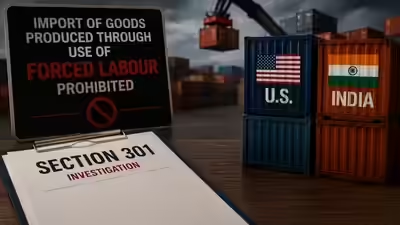
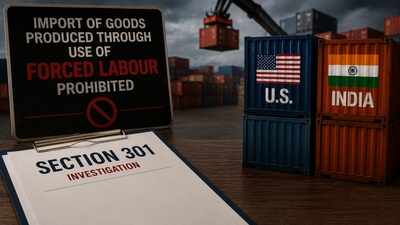
NEW DELHI: Amid US Trade Representative’s Section 301 probe on failure of 60 countries, including India, to check imports using forced labour, govt has decided to insert a new clause seeking to block the entry of specified goods and other inputs, while reiterating that the shipment of such goods into the country is prohibited.The clause is proposed to be inserted into the Foreign Trade Policy, which will allow the Directorate General of Foreign Trade (DGFT) to notify goods that are prohibited based on an investigation.Along with this, govt has decided to use International Labour Organisation’s (ILO) definition of forced labour as part of its exercise to “strengthen the foreign trade policy framework for restricting import of goods produced through forced labour”, DGFT said.ILO’s definition based on Forced Labour Convention of 1930 defines it as all work or service extracted from a person under “the menace of any penalty and for which” the individual “has not offered himself voluntarily”.
‘Govt notification signals strong legal framework’
The notification issued Monday will be effective after 30 days, by which time USTR’s recommendati-ons are expected to be in place.Following the setback from US supreme court, which termed US President Donald Trump’s reciprocal tariffs using emergency powers illegal, the administration had ordered two investigations — one involving forced labour and the other on structural excess capacity — which included India among several countries.USTR, which concluded hearings into the case, had proposed 12.5% additional tariff on over 50 countries, including India, for their alleged failure to check imports using forced labour, a charge that govt has denied.On Monday, commerce secretary Rajesh Agrawal had said the framework agreement between India and the US may find “possible pathways” to deal with the probes.“India’s notification signals that it is strengthening its domestic legal framework in line with international standards, a step that could strengthen its position in future trade negotiations and market-access discussions,” Ajay Srivastava, founder of trade research outfit GTRI said Tuesday.“By adopting the ILO definition verbatim, India aligns itself with the same international benchmark the US invokes domestically… This is the principled core: India is not merely rebutting the US charge, it is asserting that it too can police forced labour in its supply chains,” said EY India trade policy leader Agneshwar Sen.
About the Author