18-year-old New York student Amy Xiao has used computational modelling and lab experiments to investigate whether a protein called citrin could offer a new route towards cancer treatment. Her research examined how changes in the gene responsible for producing the protein may be linked to better survival outcomes in cancer patients. By combining publicly available patient data, AI and computer simulations, she identified a possible weakness in cancer cells and explored existing medicines that could target it. Her work earned her recognition as a 2025 Davidson Fellow and a finalist in the Regeneron Science Talent Search.
How did Amy Xiao explore a potential new target for cancer treatment
Xiao’s project began with a question about citrin and its possible role in cancer. The protein is involved in the processes cells use to manage substances needed for their normal functioning. Xiao wanted to find out whether changes affecting this protein could reveal a weakness in cancer cells.According to the Davidson Institute’s profile, her project brought together clinical data, computer-based protein modelling and laboratory experiments. The work was titled Exploring Citrin as a Therapeutic Target for Cancer Treatment Through a Clinical, Pharmacologic and Metabolic Lens. Its central aim was to investigate whether the protein could become a useful target for future cancer research.

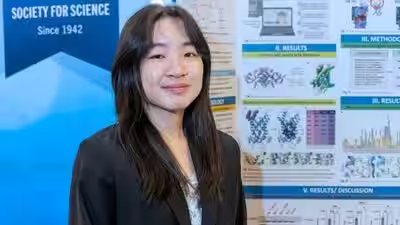
She studied how the protein citrin is involved in cancer. Analysis of a public cancer patient database showed that changes in the citrin gene were linked to better cancer survival. Image Credit: Davidson Institute
What did cancer patient records reveal
Xiao first turned to a publicly available database containing information about cancer patients. The Davidson Institute reports that she found an association between certain changes in the citrin gene and better survival outcomes.The result gave her a promising lead, but it also raised another problem. Patient data could reveal a relationship without explaining what caused it. To understand the possible reasons behind the pattern, Xiao needed to investigate what the genetic changes did to the protein itself.So she studied how the gene’s changes might influence the structure and function of citrin. If these alterations influenced the way cells processed essential substances, they could help explain the association she had observed.The finding was not proof that targeting citrin would help patients survive cancer. Instead, it gave Xiao a direction to explore through further modelling and experiments.
Artificial intelligence helped her studying citrin
Xiao used AlphaFold, an artificial intelligence system that predicts the three-dimensional shapes of proteins, to model normal citrin and altered versions of it. According to the Davidson Institute, these models helped her examine how genetic changes could affect the protein.A protein’s shape helps determine how it works. Comparing different versions can give scientists clues about why a particular alteration matters, even when its effects are not immediately obvious from genetic data alone.Xiao’s models suggested that some of the genetic changes affected citrin’s structure and function. This helped her investigate a possible explanation for the pattern found in the patient database.The project also reflected her interest in using computing to tackle scientific questions. Her Davidson Institute profile describes how she challenged herself to develop an independent research project using computational tools on her MacBook Pro, building on her experience with laboratory procedures.
What happened when she reduced citrin in cancer cells
Computer models offered clues, but Xiao also wanted to examine what happened inside actual cancer cells. She used CRISPR, a gene-editing technique, to reduce citrin production in colon cancer cells.She then analysed the cells’ metabolic changes using gas chromatography–mass spectrometry, a laboratory method for examining chemical substances in samples. The Davidson Institute reports that the experiments revealed a depletion of cytosolic aspartate in cells producing less citrin.Aspartate is important for several processes that cells need to grow and function. Its reduced availability suggested that changing citrin production could interfere with the resources cancer cells require.This was an essential part of the investigation, because it allowed Xiao to probe the protein’s possible role beyond computer simulations. The results offered a potential explanation for how citrin might affect cancer cell metabolism.However, the experiments did not establish a treatment or demonstrate that the approach would work in people. Further research would be necessary to determine whether targeting citrin could be effective and safe.
Could existing medicines target the protein
Xiao also investigated whether medicines already available could potentially inhibit citrin. According to the Davidson Institute, her computer simulations identified drugs approved by the US Food and Drug Administration as possible candidates.Such an approach could help researchers decide which compounds are worth looking at more closely. But a computer model can show a drug might interact with a protein, not that it will have the desired effect in living cells or patients. Any potential treatment would require further testing.Xiao hopes her findings will encourage scientists to investigate citrin more closely. Her work also produced a model that could help researchers study structural changes associated with citrin deficiency.
Her cancer research brought recognition in 2025
The project earned Xiao a place among the Davidson Institute’s 2025 Fellows, along with a $50,000 scholarship. She was also named a finalist in the Regeneron Science Talent Search, organised by Society for Science.Her interests extend beyond lab work and computing. According to Society for Science, Xiao attended Garden City High School in New York, co-founded and led its programming club, participated in the VEX robotics club and co-led the Science Olympiad team.Music has also been part of her life. The Davidson Institute reports that she is a classically trained violinist who attended the Manhattan School of Music’s pre-college programme. She also enjoys drawing, digital art and journalling. Xiao planned to attend Yale University’s first-year Directed Studies programme, with interests spanning science, computing and the arts.
About the Author