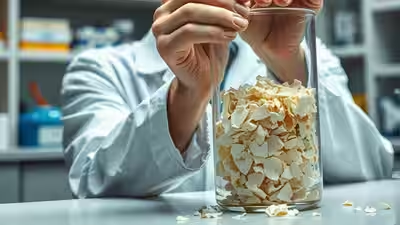
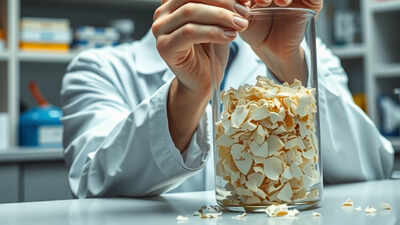
A seventh grader from Palatine, Illinois, has turned eggshells into calcium carbonate crystals and used them to investigate whether the mineral can affect bacterial growth. Shrikari Punjala, a student at Quest Academy, is one of 30 finalists in the 2026 Thermo Fisher Scientific Junior Innovators Challenge. Her project, “How Do Calcium Carbonate Crystals Affect Bacterial Growth?”, was inspired by her research into Sporosarcina pasteurii, a bacterium known for its role in calcium carbonate biomineralisation. She extracted calcium carbonate from eggshells using acetic acid, then tested the crystals against four bacterial species grown on agar plates. Society for Science reports that bacterial coverage after the crystals were added was 55% for Aeromonas sobria, 65% for Sporosarcina ureae, 66.25% for Escherichia coli and 71.25% for Bacillus subtilis. The organisation says the results showed that the calcium carbonate inhibited bacterial growth.
Punjala joins the 2026 Junior Innovators Challenge top 30
The Thermo Fisher Scientific Junior Innovators Challenge is run by Society for Science and is described by the organisation as the nation’s premier STEM research competition for middle-school students. The 30 finalists were selected from the Top 300 Junior Innovators, who were chosen from 1,997 entrants. The finalists represent 17 states and Puerto Rico, with Environmental and Earth Sciences the most prevalent project category among them, according to Society for Science’s 2026 finalist announcement and competition press release.The competition reaches about 60,000 students annually through Society for Science’s Affiliated Fair network. Students qualify to enter by placing in the top 10% of participants at a Society-affiliated science fair. Every finalist receives a $500 cash award, while their schools receive $1,000 for STEM activities. During Finals Week in Washington, DC, from October 23 to 28, judges will assess the students’ research and, in team challenges, their communication, creativity and collaboration. The finalist announcement also says critical thinking will be part of the evaluation. Away from her research, Punjala is active in tennis, badminton, pickleball and volleyball and is interested in debate. She says debate has strengthened her speaking skills and encouraged her to consider viewpoints different from her own. She has also participated in the Invention Convention, an experience she says sparked her interest in biomedical engineering. She describes biomedical engineering as a field that combines biology and invention.
Why Punjala tested calcium carbonate against bacteria
Punjala’s project began with Sporosarcina pasteurii, a soil bacterium that has been widely studied for its ability to contribute to calcium carbonate formation. A 2021 review published in Microorganisms describes S. pasteurii as a Gram-positive soil bacterium with very high urease activity and identifies it as the most frequently used strain in biomineralisation research. That research led Punjala to a different question: what happens when calcium carbonate is introduced to bacteria rather than being produced through bacterial activity? Society for Science reports that her reading suggested calcium carbonate might inhibit some bacterial species while allowing others to prosper, prompting her to test the mineral against several types of bacteria.For her source of calcium carbonate, Punjala used eggshells. A 2022 review in Frontiers in Materials reports that chicken eggshells contain about 94% to 97% calcium carbonate, predominantly in the calcite form. The review also examines methods for producing calcium carbonate from eggshells. Eggshell waste has also been studied as a material for other applications. A 2021 review in Sustainable Materials and Technologies titled “Food waste eggshell valorisation through development of new composites: A review” examines research into using eggshell waste in the development of composite materials and discusses its potential for waste valorisation.
How the calcium carbonate experiment was conducted
Punjala’s experiment involved four bacterial species: Bacillus subtilis, Escherichia coli, Aeromonas sobria and Sporosarcina ureae. After obtaining calcium carbonate from eggshells with acetic acid, she grew the bacteria on agar plates and incubated them at 30°C for three days. She then added the calcium carbonate crystals and recorded the bacterial coverage, according to the Society for Science. Testing several species allowed Punjala to compare their responses to the same mineral. Her background research had suggested that calcium carbonate could affect different bacteria in different ways, giving her four species to examine in the experiment.
Calcium carbonate reduced bacterial coverage in all four species
Society for Science reports that bacterial coverage after calcium carbonate was added was 55% for A. sobria, 65% for S. ureae, 66.25% for E. coli and 71.25% for B. subtilis. All four species showed lower reported coverage after the calcium carbonate was added. Society for Science concludes from the experiment that the calcium carbonate inhibited bacterial growth. The profile doesn’t give starting coverage or plate counts. The experiment examined bacterial growth under the conditions used in Punjala’s test. Its findings do not establish how calcium carbonate would affect other bacterial species or whether the same response would occur under different experimental conditions.
Calcium carbonate and bacterial biomineralisation
Research into S. pasteurii has explored calcium carbonate biomineralisation for applications beyond the question tested by Punjala. The 2021 Microorganisms review discusses uses including self-healing concrete, bio-bricks, desert sand solidification and the disposal of harmful metals. Those applications involve using bacterial activity to produce or deposit calcium carbonate, whereas Punjala’s experiment starts with calcium carbonate extracted from eggshells and examines its relationship with bacterial growth. The two areas therefore approach the mineral from different directions. Punjala’s experiment adds eggshell-derived calcium carbonate to cultures of four bacterial species and measures the resulting bacterial coverage. The reported results showed lower coverage across all four species, with the largest reported reduction in the experiment occurring for A. sobria, at 55% coverage.
From a school experiment to the national stage
Punjala is now among the 30 students who will take their projects to the 2026 Thermo Fisher Scientific Junior Innovators Challenge Finals Week in Washington, DC, from October 23 to 28. She will present her research alongside finalists from across the United States and Puerto Rico, bringing an experiment that began with eggshell-derived calcium carbonate into a national middle-school science competition.
About the Author