
Every Navratri is sacred. But once in a while, the planets line up in a way that makes the nine days feel even more special. 2026 is one of those years.On 11 October, as families install the Kalash and invite Maa Durga home, the Moon and Jupiter are expected to form Gajakesari Yoga. Then, as the festival winds down with Ashtami, Navami and Dussehra, the same yoga forms all over again. So the Goddess is welcomed under it, and bid farewell under it too.
Guru Is Exalted, and That Doesn’t Happen Often
Jupiter needs about twelve years to travel once around the zodiac. It stays roughly a year in each sign. That means it reaches Kark, its sign of exaltation, only once every twelve years or so.This time, Guru entered Kark on 2 June 2026 and will stay until 31 October. Every single day of Sharad Navratri falls inside that window.The last Navratri with an exalted Jupiter was in 2014. Plenty of college students celebrating this year were in primary school back then. And the next one won’t come around until the late 2030s.
How Gajakesari Yoga Forms
Gaja means elephant. Kesari means lion. The name hints at a mix of power and grace.Technically, the yoga forms when the Moon sits in a kendra from Jupiter. Kendra means the 1st, 4th, 7th or 10th house. With Guru in Kark, the Moon creates this yoga whenever it passes through Kark, Tula, Makar or Mesh.The Moon changes sign about every two and a half days. And this year, its path fits Navratri almost perfectly.Around 11 to 13 October, it should be moving through Tula, four houses away from Jupiter. Ghatasthapana falls here, along with the days of Maa Shailputri and Maa Brahmacharini.By 18 to 20 October, the Moon reaches Makar. Now it sits exactly opposite exalted Jupiter, a 7th-house link that’s counted among the strongest versions of this yoga. Durga Ashtami, Maha Navami and Vijayadashami all land in this stretch.Timings move a little from city to city. Your local panchang will give the exact hours.
An Elephant on Earth, an Elephant in the Sky
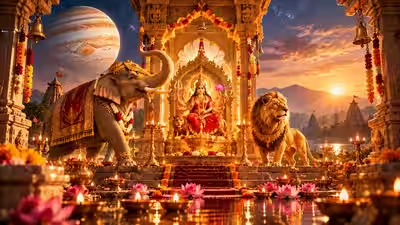
Here’s a detail that’s easy to miss. Since Navratri starts on a Sunday this year, scriptures say Maa Durga arrives riding an elephant.So the Goddess comes on a gaja, while Gajakesari Yoga shines above. Grandmothers will probably be pointing this out at family gatherings for years.
The Closing Days Carry Extra Weight
The last three days of Navratri pile one auspicious marker on top of another.Sarvartha Siddhi Yoga forms on the afternoons of 18 and 19 October. Dussehra on the 20th is an abujh muhurat, so auspicious that you don’t need to look up a separate timing. And the Moon passes through Shravana Nakshatra, which is dear to Lord Vishnu and traditionally linked with Vijayadashami.Add Gajakesari Yoga to that mix, and these three days rank among the most blessed of the whole year.
What This Yoga Does for Your Prayers
Old texts tie Gajakesari with respect, lasting wealth and good judgement. Spiritually, Jupiter stands for the guru and divine grace. The Moon stands for the mind.When the two support each other, the mind is believed to open up more easily. Mantras flow better. It gets easier to sit still. Experienced sadhaks often say that practice done under Gajakesari bears fruit faster than usual.So if you’ve been putting off starting a daily Durga Saptashati path or a mantra sankalp, Ghatasthapana morning gives you the perfect excuse to begin.
Making the Most of These Nine Days
Start with a sankalp on 11 October, right when you set up the Kalash. Think about the one blessing you want most from Maa Durga this year. Not a long list. Just one. Some families like to write it on a small slip of paper and tuck it beneath the Kalash, where it stays for all nine days.The days in between are where most people lose steam. The fasting gets tiring by day five, and office work doesn’t stop for Navratri. Still, try to keep the evening aarti going without a break. Even ten minutes in front of the diya counts.Then save your best effort for the end. If you’ve been doing a Saptashati path or counting a mantra jaap, aim to complete it between 18 and 20 October, when Gajakesari returns. Kanya Pujan on 19 October deserves your full attention. And on Dussehra, it’s a good idea to take that first step on something you’ve been delaying for months. A new course, a business plan, even a difficult phone call.
A Simple Offering for Guru and Chandra
On any Gajakesari day, make kheer with milk, rice and a pinch of saffron, and offer it to Maa Durga. The milk belongs to the Moon, and the saffron to Jupiter.Share the prasad with the elders and young girls at home. Afterwards, sit quietly and chant “Om Gurave Namah,” then “Om Somaya Namah,” eleven times each.
About the Author