
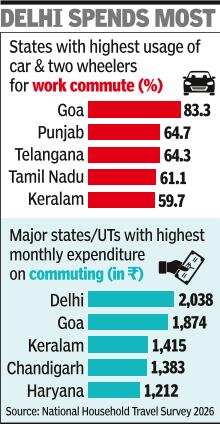
NEW DELHI: Long traffic snarls, a common feature on roads across the country, may be linked to how people commute to work. Only 15% of workers use public transport such as buses, trains, trams or auto-rickshaws, while 46% rely on two-wheelers or cars, according to the first-ever National Household Travel Survey (NHTS) by the National Statistics Office (NSO).Two-wheelers account for 43% of workers’ commute nationally and cars for 3%. In urban areas, reliance on these vehicles is higher, with 53% of workers using two-wheelers and 5.7% travelling by car.
28.3% of people reach workplace on foot: NSO
Walking is the second most common mode of work commute in the country, accounting for 28.3% of workers, 10.7% use bicycles. More than a third of rural workers (36%) walk to work, compared with just 14% in urban areas, as per the data. The survey was conducted between July 2025 and June 2026 and included trips which are longer than 1 km. Travelling to and fro has been counted as two trips in the survey.The survey showed a worker takes an average of 25 minutes to reach the workplace. In urban areas, the commute takes 27 minutes, compared with 23 minutes in rural areas. The morning commute remains heavily concentrated before 10 am, with nearly 95% of workers leaving home for work then.In terms of cost, workers spend an average of Rs 785 a month on commuting, with men spending substantially more (Rs 835) than women (Rs 533). The gap widens further in rural areas, where men spend more than twice as much as women — Rs 674 against Rs 307.
Share your thoughts in the comments
Be respectful · TOI community guidelines
In contrast, student mobility shows a markedly different pattern. Walking is the single largest mode, accounting for 37% of students travelling to educational institutions, followed by buses at 29.5% and bicycles at 15.8%. Around 88% reach their institutions within 30 minutes, while the average journey takes 23 minutes. Nearly four in five students leave for school between 7 am and 10 am.Besides meeting the railway ministry’s specific data requirements, the survey is expected to provide insights into how, when and why people travel. “Information on travel patterns and public transport use will help identify gaps in existing transport systems, assess accessibility, optimise routes and improve service frequency and scheduling,” said NSO in a statement.
About the Author