Some people move through the world treating almost everything as ordinary. Others notice something remarkable in the same ordinary details. A line widely credited to Albert Einstein names that exact split. “There are two ways to live your life. One is as though nothing is a miracle. The other is as though everything is a miracle,” it goes. Neither option asks anyone to abandon reason. It simply asks what happens once a person stops being surprised by anything at all, and whether that stopping is really a sign of maturity or just a quiet loss of attention that nobody notices happening until much later, once the wonder has already gone missing entirely.
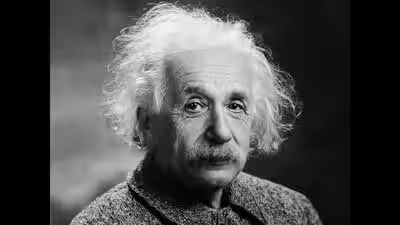
Quote of the day by Albert Einstein
“There are two ways to live your life. One is as though nothing is a miracle. The other is as though everything is a miracle”
A line with genuinely disputed origins
Worth being upfront about here: despite circulating everywhere under Einstein’s name, nobody has ever produced a book, letter or interview where he actually wrote or said this. Several other names have been floated over the years as the real source, including the Anglican clergyman Basil Wilberforce, the geographer Gilbert Fowler White, and Robert E. Hinshaw. The idea itself is worth taking seriously regardless of who first put it into words this precisely.
What the two options are actually describing
Treating nothing as a miracle means processing the world purely through explanation, a sunset reduced to atmospheric scattering, a relationship reduced to social interaction. Treating everything as a miracle does not require rejecting any of that science. It means noticing that an explanation and a sense of wonder can exist about the exact same thing at once. Understanding the physics behind a rainbow does not make it any less worth looking at.
Why familiarity quietly erodes wonder
The first time someone sees a genuinely beautiful place, it tends to hold their full attention. Seeing the same view daily eventually dulls that response, not because the place changed, but because attention did. The same pattern shows up in relationships and everyday routines that once felt significant and gradually stopped registering as anything worth noticing at all.
Why this fits oddly well with a physicist
Einstein’s actual career was built on explanation, mathematics, and rigorous observation, which makes a quote about wonder sit in interesting tension with his real body of work regardless of who actually coined it. Scientific understanding rarely eliminates amazement in practice. Often it deepens it, since learning more about how something works tends to reveal how much more there still is left to explain.
Other famous quotes attributed to Albert Einstein
- “The important thing is not to stop questioning. Curiosity has its own reason for existing.”
- “Imagination is more important than knowledge.”
- “Life is like riding a bicycle. To keep your balance, you must keep moving.”
- “A person who never made a mistake never tried anything new.”
Why this quote still matters today
Modern life has made a huge number of genuinely extraordinary things feel completely routine, instant communication across continents, images from the edge of the universe delivered to a phone in seconds. Whoever actually wrote this line first, the underlying nudge still holds up. Look again at whatever has become invisible through sheer repetition, and it often turns out to be exactly as remarkable as it always was.
About the Author