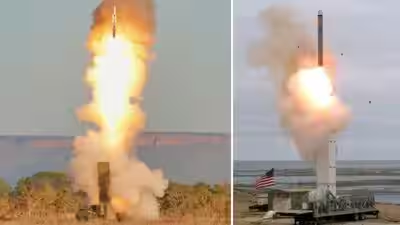
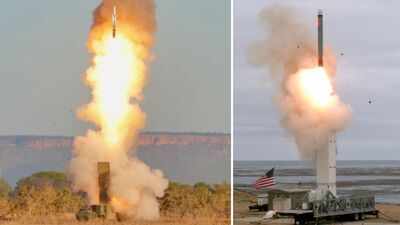
The US Army has laid out a new strategy for a potential conflict with China in the Indo-Pacific, detailing how its forces could help counter Beijing’s military threat, defend key bases and support Taiwan in a conflict.According to Military Watch Magazine, the US Army’s October 2026 operational guidance outlines how its forces could conduct long-range strikes within the First Island Chain, deploy dispersed combat formations and sustain operations across contested supply routes in a potential conflict with China.The document also includes a hypothetical Taiwan contingency scenario examining how US Army strike capabilities could be deployed from northern Luzon in the Philippines.The guidance identifies long-range precision fires as a key requirement for operations inside the First Island Chain, calling for sufficient range and ammunition capacity to strike adversary launch sites and maritime targets across the western Pacific.It also calls for capabilities to penetrate anti-access and area-denial (A2/AD) defences, which are designed to restrict an adversary’s ability to operate in a contested region.The guidance also stresses the need to protect US forces and bases from missile attacks, one-way attack drones and other threats in a contested environment.It calls for stronger air and missile defences, counter-drone capabilities and more resilient military installations, alongside the dispersal of forces and equipment to reduce their vulnerability to concentrated attacks.The Army also identifies the need to protect logistics hubs and power-projection facilities from long-range strikes, sabotage and cyberattacks.Beyond strike capabilities and base protection, the guidance emphasises the need to sustain military operations over long distances and in environments where supply routes may be disrupted.It calls for decentralised supply hubs, alternative transportation routes and autonomous systems to deliver ammunition and other essential supplies to dispersed forces.The Army also highlights the role of forward-deployed manufacturing capabilities in repairing equipment and producing critical components closer to the battlefield, reducing reliance on vulnerable supply lines.The guidance further calls for closer coordination between US forces and regional allies and partners, including access to bases, ports, airfields and overflight routes needed to move troops and equipment.China’s growing pressure on TaiwanThe US Army’s operational guidance comes amid growing tensions between China and Taiwan, with Beijing continuing to claim the self-governed island as part of its territory and refusing to rule out the use of force to bring it under its control.China has expanded its military activities around Taiwan, including air and naval operations, increasing concerns over the risk of a conflict in the Indo-Pacific.Taiwan rejects Beijing’s sovereignty claims and continues to strengthen its defences, while the United States opposes any attempt to change the status quo by force and provides Taiwan with defensive arms.Washington’s support for the island remains a key factor in regional security, although it has not given an unconditional public guarantee of direct military intervention in every possible conflict.Recent developments have added to these concerns. Taiwan has reported repeated Chinese military aircraft and naval activity around the island, while Beijing has also used maritime patrols and diplomatic pressure to challenge Taipei’s international standing.On October 10, the US State Department described China’s maritime actions off Taiwan as “deeply destabilising”, after Taiwan raised concerns that Chinese vessels could be rehearsing for a potential blockade.China maintains that Taiwan is part of its territory and opposes foreign military support for the island
About the Author