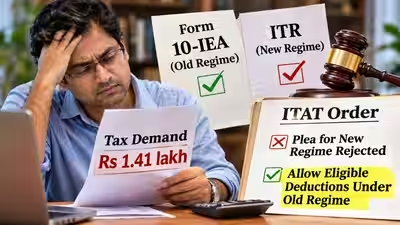
You opt out of the new income tax regime by filing Form 10-IEA, but while filing your income tax return opt for the new regime. Under what regime will your return be processed – new or old?In one such case a taxpayer ended up making contrary choices and the Income Tax Department processed his return under the old tax regime and raised a tax demand. He fought the tax addition believing that his choice in ITR should override Form 10-IEA.The Income Tax Appellate Tribunal (ITAT), Mumbai, rejected the taxpayer’s argument that the selection in his return should prevail. However, it gave him partial relief. Read to know what happened.
What the case is about
The case concerns a man’s income tax return for assessment year 2025-26. The taxpayer had opted for the new income tax regime in the preceding assessment year, 2024-25. On August 31, 2025, when he filed Form 10-IEA he opted out of the new regime and was taxed under the old income regime.However, when he filed his income tax return on September 16, 2025, declaring a total income of Rs 33,88,170, he selected the option indicating that he did not wish to opt out of the new tax regime. This was contrary to the choice that was recorded in the form he had filed earlier.The CPC processed his return under Section 143(1) of the Income Tax Act, 1961, on January 29, 2026. It took Form 10-IEA into account and raised a demand of Rs 1,41,480. Joshi sought rectification, but the CPC rejected his request under Section 154 on February 17, 2026.He then appealed to the Commissioner of Income Tax (Appeals), who upheld the adjustment. The appellate authority reasoned that the taxpayer had opted out of the new tax regime through the prescribed form, making the contrary selection in his return an incorrect claim.Before the Mumbai ITAT, the taxpayer argued that the CPC should have followed the option selected in his return instead of relying on Form 10-IEA. His counsel cited a Pune ITAT ruling in Akshay Nitin Malu v. Income Tax Officer, arguing that the choice declared in the return should be respected.He also challenged the processing of his return on the ground that the CPC had not issued prior intimation of the proposed adjustment. For this, he relied on a Bombay High Court ruling in Rallis India Ltd v. Central Processing Centre.As an alternative, the man argued that if the old tax regime applied because of Form 10-IEA, he should be allowed the deductions available under that regime. His claims included Rs 1.5 lakh under Section 80C, Rs 50,000 under Section 80D and Rs 50,000 under Section 80TTB.
What ITAT Mumbai said
The tribunal examined whether the taxpayer could rely on the selection in his return when it contradicted the prescribed form he had already filed.The bench noted that the taxpayer had opted for the new income regime in assessment year 2024-25 and subsequently filed Form 10-IEA to move to the old income tax regime for assessment year 2025-26.Under Section 115BAC, taxpayers with business or professional income must exercise the relevant option in the prescribed manner, and the rules restrict when that choice can be withdrawn.The tribunal held that the selection in the return could not override the prescribed form.It observed: “In our opinion, once a specific form has been prescribed for opting out of the new tax regime, the assessee cannot be permitted to choose for the new tax regime otherwise than filing said form under the provisions of the Act.”It also distinguished the Pune ITAT ruling cited by the taxpayer. In that case, the taxpayer had filed Form 10-IE to opt out of the new regime and had also filed the return under the old regime.This case was different because the form and the return indicated conflicting choices. The tribunal noted: “But in the instant case, facts are different. In the Form 10-IE filed, assessee is opting out of new tax regime and choosing old tax regime. But in the return of income, wrong box has been ticked.”The bench also rejected the taxpayer’s argument that the CPC had processed his return without prior intimation. It had asked him to produce evidence from the income tax portal showing that no intimation had been sent by email or physical letter, but he did not provide the requested material.The tribunal distinguished the Rallis India case because the department had acknowledged there that no notice or proposed adjustment had been issued. It therefore dismissed this ground of appeal.The taxpayer, however, succeeded on his alternative plea concerning deductions. The tribunal held that if the old income tax regime applied on the basis of Form 10-IEA, the deductions available under that regime also had to be considered.It observed: “If CPC is holding that assessee has opted out of the new tax regime and old tax regime of this is applicable, then the deduction entitled under the old tax regime should be allowed to the assessee.”The bench set aside the appellate order on this limited issue and restored the matter to the Assessing Officer to examine the eligible deductions. The tribunal also recorded that “In our opinion, there is a merit in the submission of the assessee.”The ITAT pronounced its order on September 17, 2026, and partly allowed the appeal. It did not cancel the Rs 1,41,480 demand outright or automatically grant all the deductions claimed. The Assessing Officer must examine the taxpayer’s eligibility for deductions under the old regime.
About the Author