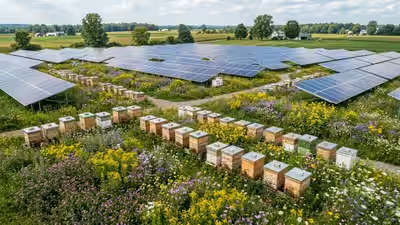
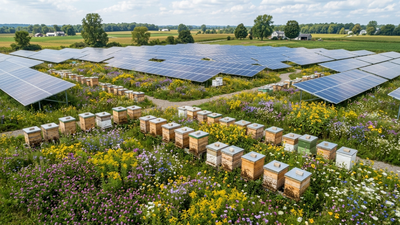
An Ohio solar site is becoming a working landscape for more than just electricity generation. At Big Plain Solar in Madison County, more than 3 million honey bees are being supported across a site that includes solar panels and managed beehives, as reported by Leeward Renewable Energy. The project works with veteran-led beekeeping organisations to provide suitable habitat around the facility, creating space for bees among an energy installation. More than 50 hives are currently supported there, with pollinator-friendly planting forming part of the wider land management approach. The arrangement is an example of how land around solar panels can also be used for agriculture and habitat, depending on the design and management of the site.
More than 3 million bees are living around the solar panels
Big Plain Solar, in Madison County, Ohio, supports more than 50 honey bee hives containing an estimated 3 million bees. The hives are managed with help from Frontline Hives and Wind & Sky Apiaries, including veteran-led beekeeping operations. The idea is not to turn the solar facility into a conventional farm. Instead, areas around the infrastructure can be managed in ways that provide resources for pollinators while the panels continue to generate electricity.Pollinator habitat can include flowering plants and other vegetation that provide food and shelter for insects. At Big Plain Solar, this approach has been combined with beekeeping, giving the site another agricultural use alongside energy production.Honey bees also have a wider role in American agriculture. The US Department of Agriculture estimates that honey bees pollinate about $15 billion worth of crops in the United States each year, covering more than 130 kinds of fruits, nuts and vegetables.
Veteran beekeepers are helping manage the habitat
The beekeeping work at Big Plain Solar involves veteran-led partners, including Frontline Hives and Wind & Sky Apiaries. Their involvement connects the solar site with an established form of agricultural land use rather than treating the space around the panels as unused ground.Keeping hives near suitable flowering plants can provide bees with access to forage during the season. The surrounding vegetation can also support other pollinating insects, although the exact ecological benefits depend on the species planted, local conditions and how the land is managed.For the beekeepers, the solar site provides another setting in which hives can be maintained. For the solar operator, it forms part of a broader approach to land stewardship. The panels remain the primary infrastructure, but the land between and around them does not necessarily have to serve only one purpose.
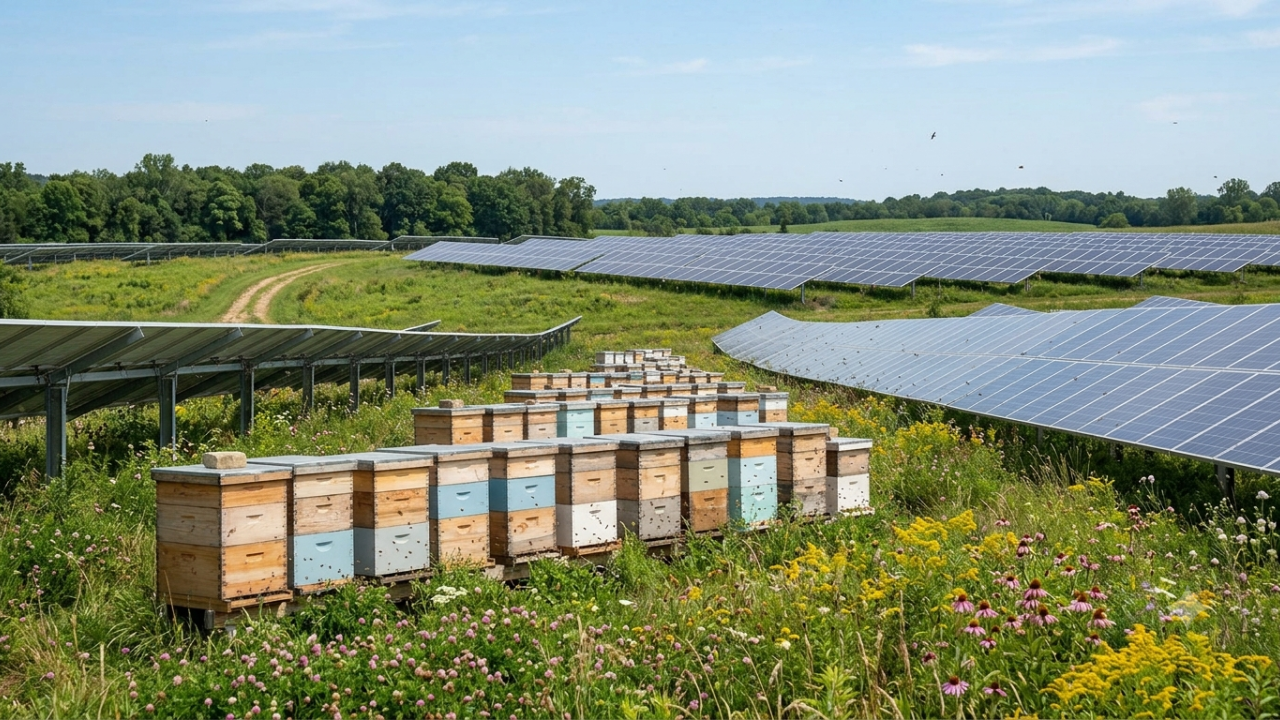
What happens between the solar panels can matter too
Solar farms occupy large areas of relatively open land, and the ground beneath and around the equipment can be managed in different ways. Some sites may incorporate grazing animals, while others can accommodate pollinator planting or other forms of agricultural activity. Agrivoltaics is the term used for combining solar energy with agriculture. The US Department of Energy includes crop production, livestock grazing and pollinator habitat among the possible forms of agriculture that can exist underneath or between solar panels.The arrangement can vary considerably from one project to another. Panel spacing, soil conditions, vegetation, access requirements and the type of farming activity all affect what can realistically be done. For pollinators, the important part is what is available at ground level. Flowering plants can provide nectar and pollen, while leaving suitable areas between infrastructure can create additional habitat.
The land can serve more than one purpose
Solar and farming are often associated with the same basic landscape characteristics. Both can make use of open, relatively level areas, which means the two activities can sometimes be accommodated on the same property. For farmers, solar development can also create an additional source of income where land is leased for energy generation. Other arrangements can involve solar systems on farm buildings or the use of land for agrivoltaic projects.The US Department of Energy’s Solar Energy Technologies Office is examining the opportunities and trade -offs involved in combining agriculture with solar generation. The results can depend heavily on the particular site and the agricultural activity being considered. Big Plain Solar offers one example at the pollinator end of that spectrum. Instead of focusing on crop production between the panels, the site incorporates managed bee colonies and habitat intended to support pollinators.
Harvey Solar is also being assessed for land stewardship
The approach is relevant to another Ohio project being developed by Leeward Renewable Energy. The Harvey Solar project is currently in its design phase, during which engineering, site layouts and other project details are being developed with state and local agencies. Land stewardship options are being considered as part of that process. Potential measures include beekeeping, sheep grazing and pollinator plantings.It has not yet been decided which of those options will form part of the final Harvey Solar design. The project is expected to move into initial site preparation and early groundwork in summer 2026, with construction planned for autumn and an anticipated operating date in 2028.That makes the planning stage significant for how the land will eventually be used. Decisions made before construction can determine where habitat, agricultural activity and other stewardship measures can fit around the solar infrastructure.
Ohio’s solar sites are becoming part of a wider land-use question
The presence of bees at Big Plain Solar reflects a broader issue surrounding solar development: what happens to the land that surrounds the equipment once a project is operating. A solar installation does not automatically determine how every part of a site must be managed. Depending on the project, there can be opportunities for grazing, planting or other agricultural uses. Those possibilities have to work alongside maintenance access, electrical equipment and the physical layout of the panels.At Big Plain Solar, the combination is relatively straightforward. More than 50 hives are being maintained on a site already producing solar power, while veteran beekeepers help manage the colonies and pollinator-friendly areas support their surroundings.The result is a solar facility where electricity generation and beekeeping occupy the same landscape. For projects still in development, such as Harvey Solar, similar possibilities are being considered before the final site arrangements are set. For now, the millions of bees at Big Plain Solar offer a concrete example of what can happen when the space around solar infrastructure is treated as land with another use, rather than simply ground beneath the panels.
About the Author