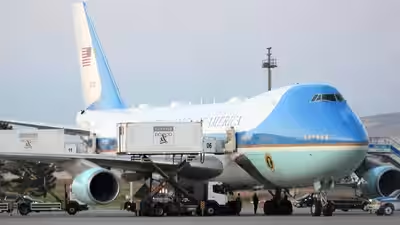
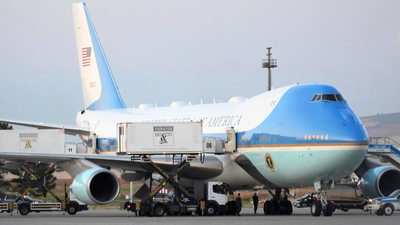
Turkey spent eight months and more than $120 million transforming a former military airport before one of the world’s largest passenger aircraft could touch down. The aircraft, a Boeing 747-8 gifted by Qatar to the United States and expected to be converted into an interim presidential aircraft while Boeing continues work on the delayed VC-25B Air Force One programme, required major infrastructure upgrades at Ankara’s Etimesgut Airport ahead of the 2026 NATO summit. Engineers widened and extended the runway, upgraded taxiways and navigation systems, and expanded the airport to meet the demanding requirements of the jumbo jet. The project highlighted how a single aircraft can reshape an entire airport, with its enormous size and weight forcing engineers to redesign key parts of the facility before it could safely operate there.
Turkey rebuilt an entire airport for Donald Trump ‘s Boeing 747
The extensive reconstruction took place at Etimesgut Airport, a former military airbase in Ankara that reopened as a dedicated facility for diplomatic and government aircraft ahead of the NATO summit.According to Turkish officials, the project lasted eight months and involved more than $120 million in upgrades. While the airport was intended to handle dozens of visiting heads of state and VIP aircraft during the summit, the Boeing 747-8 donated by Qatar was by far the most demanding aircraft expected to operate there.The airport now serves as a secondary gateway alongside Ankara Esenboğa Airport, helping manage high-level diplomatic traffic while accommodating some of the world’s largest government aircraft.Unlike ordinary passenger jets, aircraft of this size cannot simply land at any international airport. Their enormous dimensions require wider runways, larger parking areas and greater clearance between aircraft, meaning airports often need specialised infrastructure before they can safely handle them.
Why the Boeing 747-8 required such extensive upgrades
The Boeing 747-8 is the largest commercial aircraft Boeing has ever built.Measuring more than 76 metres (250 feet) in length with a 68.4-metre wingspan, the aircraft is significantly larger than the Boeing 747-200B models currently used as Air Force One. At maximum take-off weight, it weighs around 442 tonnes, making it Boeing’s heaviest commercial passenger aircraft.To put that into perspective, the aircraft is almost as long as a football pitch and weighs roughly the same as more than 250 average family cars. Its enormous wingspan also means it needs far more space to manoeuvre on the ground than conventional wide-body aircraft.Those dimensions place it in ICAO Aerodrome Reference Code F, the highest airport classification used by commercial aircraft. Only aircraft such as the Boeing 747-8 and Airbus A380 require Category F airport infrastructure.Many airports around the world meet Category E standards, but the Boeing 747-8’s greater wingspan demands wider runways, taxiways and greater clearance around aircraft movements.
The runway had to become wider and longer
The biggest engineering challenge was not simply extending the runway but redesigning it to accommodate the aircraft safely.Engineers increased the runway length from 2,450 metres to 3,000 metres, providing enough distance for the heavy aircraft to operate comfortably, particularly during long-haul departures.Even more significant was widening the runway from 42 metres to 60 metres, bringing Etimesgut Airport into compliance with ICAO Category F standards.The extra width gives pilots more room to keep the aircraft safely aligned during take-off and landing. It also ensures the giant wings remain clear of nearby taxiways, lighting systems and other aircraft operating on the ground.Without those upgrades, the aircraft would have required operational restrictions or might not have been able to use the airport under normal international safety standards.
Why Ankara’s location made the project even more important
The airport sits around 808 metres (2,650 feet) above sea level.Higher elevation means thinner air, while Ankara’s summer temperatures further reduce air density. Thin air makes it harder for aircraft engines to generate thrust and for wings to produce lift, meaning larger aircraft need more runway to accelerate before taking off.For a fully fuelled Boeing 747-8 capable of flying intercontinental routes, the longer runway provides a much greater operational safety margin during take-off, particularly in Ankara’s high-altitude and warm-weather conditions.The longer runway also gives pilots a greater safety buffer when the aircraft is carrying large amounts of fuel for long-distance flights.
Bigger than the current Air Force One
The aircraft is considerably larger than the two VC-25A presidential aircraft currently serving as Air Force One.Those aircraft are based on the older Boeing 747-200B, introduced in the late 1980s.The newer Boeing 747-8 is nearly six metres longer and has a wingspan roughly four metres wider than the existing presidential fleet.While those measurements may sound relatively small, they are significant in aviation. Even a few extra metres can determine whether an airport meets international standards for safely accommodating a particular aircraft, affecting everything from runway width to taxiway spacing and parking positions.The larger dimensions are one of the reasons why airports designed for today’s Air Force One may still require modifications before accommodating the newer aircraft.
A $400 million gift from Qatar
The aircraft was previously used by Qatar’s ruling family as a VIP transport before being offered to the United States.The Boeing 747-8 has been widely reported to be worth around $400 million when new. Designed for royal travel, it features luxurious interiors with spacious lounges, meeting areas and private suites that are far more elaborate than those found on commercial airliners.Before it can serve as an interim presidential aircraft, however, it would require extensive modifications, including secure communications and other specialised systems required for presidential transport.The donation attracted significant political attention in the United States, with supporters viewing it as a cost-saving measure while critics raised questions about ethics, security and the extensive work required before the aircraft could be used for presidential transport.
The airport was upgraded far beyond the runway
The reconstruction project involved much more than runway improvements.Turkey expanded the airport with a 160,000-square-metre aircraft apron capable of accommodating 44 aircraft, upgraded taxiways, installed new lighting and navigation systems, and modernised protocol facilities for visiting heads of state.The larger apron allows multiple government aircraft to park simultaneously during international summits, while upgraded navigation and lighting systems improve safety during poor weather and night-time operations.Together, the improvements transformed Etimesgut from a military airfield into a modern diplomatic aviation hub capable of supporting high-profile international events.
The aircraft has influenced airport projects before
This is not the first airport to adapt its infrastructure for the Boeing 747-8.Before being donated to the United States, the aircraft served as the Emir of Qatar’s personal jet. Its exceptional size has made it one of the most demanding passenger aircraft to operate, with airports around the world requiring suitable infrastructure to accommodate aircraft of its dimensions.Its exceptional size has repeatedly made it a benchmark aircraft for airports seeking to handle the biggest commercial jets, with infrastructure projects often designed around its demanding operational requirements.
About the Author